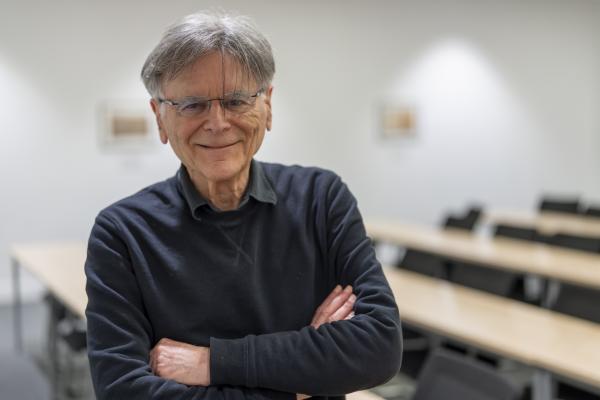
The Chern Medal 2026: A conversation with Graeme Segal
Segal has won a Chern Medal for his "visionary mathematical insights that have had an enduring influence in a wide range of fields."
Marianne Freiberger is Editor of Plus. She joined Plus in 2005 after doing a PhD and then a three year postdoc at Queen Mary, University of London. As a researcher she worked in complex dynamics, the area of pure maths that has given us the Mandelbrot set. In the world of maths communication she has been Editor-in-Chief of the Mathscareers website, given presentations to mathematicians about how to communicate their work to a wider audience, and to journalists about how to deal with maths in the media. She has been a TEDx speaker and an invited speaker at the International Congress of Mathematicians in 2010.
Together with Rachel Thomas, Marianne has co-authored several popular maths books including Numericon: A journey through the hidden lives of numbers and Understanding numbers, and were editors on the book 50: visions of mathematics. They were Science Editors for the Discovery+ documentary series Universe Unravelled about the work of the Stephen Hawking Centre for Theoretical Cosmology.
In October 2022 Marianne and Rachel received a SPI-M-O Award for Modelling and Data Support (SAMDS) from the UK's Scientific Advisory Group for Emergencies. This award recognised their work with the JUNIPER modelling consortium to provide a wide audience (including public, press, policy makers and government) with clear and accessible explanations of some of the maths that was vital in responding to the COVID-19 pandemic.
Segal has won a Chern Medal for his "visionary mathematical insights that have had an enduring influence in a wide range of fields."
John Pardon won a Fields Medal for work in geometry that sheds a light on the nature of our Universe.
Fields Medallist Wendelin Werner loves Brownian loop soups. In the second part of this article, we learn more about why they matter so much.
Fields Medallist Wendelin Werner loves Brownian loop soups. We explore what they are, why he finds them so "natural", and how they are linked to the physics of elementary particles.
Daniel Baumann will be treading in Hawking's legendary footsteps, pursuing a central question of the field: How did the Universe begin? Find out more in this article.
Causal inference is the art of discerning cause and effect from data. Find out more in this introduction.
How do you discern cause and effect when you can't do a controlled experiment? Directed acyclic graphs (DAGs) are a fun and important tool.
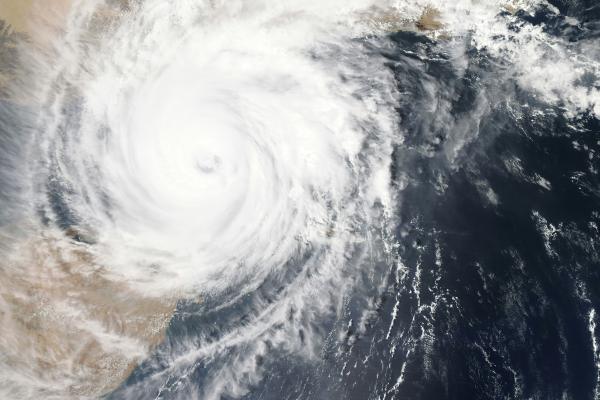
Why was the 2025 Atlantic hurricane season different from previous seasons? Early career researcher Charles Powell analysed the data, helping insurance company Inigo in the process.
Infectious diseases in hospitals cost lives and money. How can we best understand them?
Find out how deep learning can help improve the images produced by MRI, CT and PET scans, making patients more comfortable and cutting NHS waiting lists.
This year's Abel Prize has been awarded to the German mathematician Gerd Faltings for work that brings together number theory and geometry to solve equations.
A short explanation of the fundamentals of category theory.