
Article

AI and GoPro physics
Will AI one day be able to spot the equation that describes a physical process just by looking at a video of it?

Marianne Freiberger is Editor of Plus. She joined Plus in 2005 after doing a PhD and then a three year postdoc at Queen Mary, University of London. As a researcher she worked in complex dynamics, the area of pure maths that has given us the Mandelbrot set. In the world of maths communication she has been Editor-in-Chief of the Mathscareers website, given presentations to mathematicians about how to communicate their work to a wider audience, and to journalists about how to deal with maths in the media. She has been a TEDx speaker and an invited speaker at the International Congress of Mathematicians in 2010.
Together with Rachel Thomas, Marianne has co-authored several popular maths books including Numericon: A journey through the hidden lives of numbers and Understanding numbers, and were editors on the book 50: visions of mathematics. They were Science Editors for the Discovery+ documentary series Universe Unravelled about the work of the Stephen Hawking Centre for Theoretical Cosmology.
In October 2022 Marianne and Rachel received a SPI-M-O Award for Modelling and Data Support (SAMDS) from the UK's Scientific Advisory Group for Emergencies. This award recognised their work with the JUNIPER modelling consortium to provide a wide audience (including public, press, policy makers and government) with clear and accessible explanations of some of the maths that was vital in responding to the COVID-19 pandemic.
Will AI one day be able to spot the equation that describes a physical process just by looking at a video of it?

We look at the recent rise in measles cases, why it has led to a national health incident being declared, and what can be done to avert the threat.
We are very pleased to be launching this network for those working in, and with a stake in, communicating complex mathematics and data science to a variety of non-expert audiences.
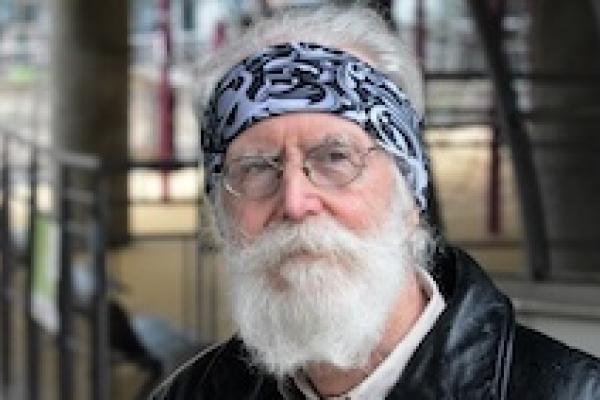
The Abel Prize 2024 has been awarded to Michel Talagrand for ground breaking contributions to probability theory and functional analysis.
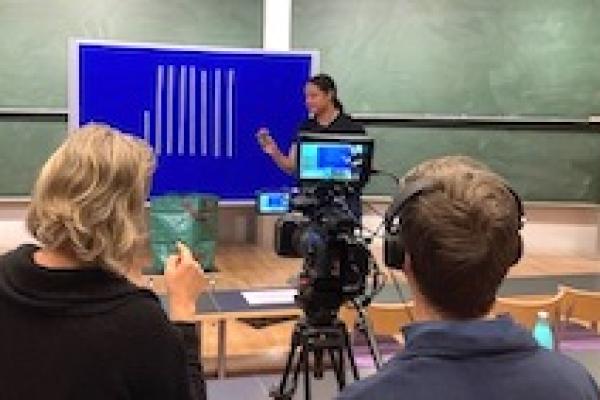
We're proud to announce the launch of a school curriculum and public engagement project which gives a hands-on experience of mathematical research and its benefits for society.

The Centre for Climate Repair has recently become our neighbour here at the Centre for Mathematical Sciences at the University of Cambridge. But what is climate repair? We talked to the Centre's Director to find out.

The mathematics of movement can describe the behaviour of all types of organisms, from cancer cells to humans.
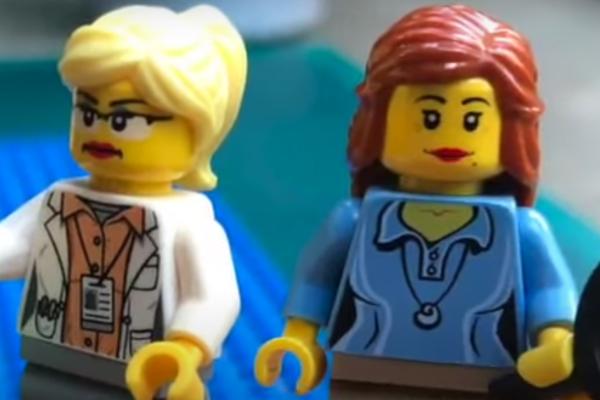
With just some simple arithmetic, you can build a basic mathematical model of how a disease might spread. Julia Gog explains how, and there's also some Lego action...
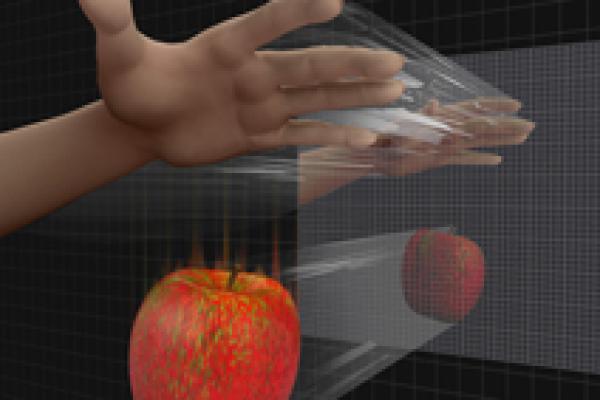
It might sound like something from science fiction, but the holographic principle might help us answer the biggest problem in modern physics.

You can explore how we might extend our model but running your own epidemic with our Lucky Dip interactivity. Follow along with Julia as she paves the way to a model that is very similar to the mathematics disease modellers use every day.

In Part 3 Julia refines our model to use one of the most important numbers in disease modelling. And there's a chance for you to explore its meaning using a new interactivity.

In the final Part we explore what other aspects we need to consider to make a model more realistic. There's an interactivity that allows you to party, commute, and visit friends and we find out more about what life as a research is like from Julia.