The Fields Medals 2026: John Pardon
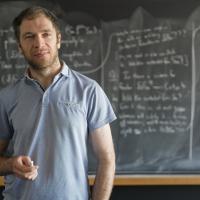
John Pardon, a mathematician at Stony Brook University in New York, has won one of this year's Fields Medals at the International Congress of Mathematicians. The Field Medal is one of the most prestigious prizes in mathematics. It is awarded every four years "to recognise outstanding mathematical achievement for existing work and for the promise of future achievement".
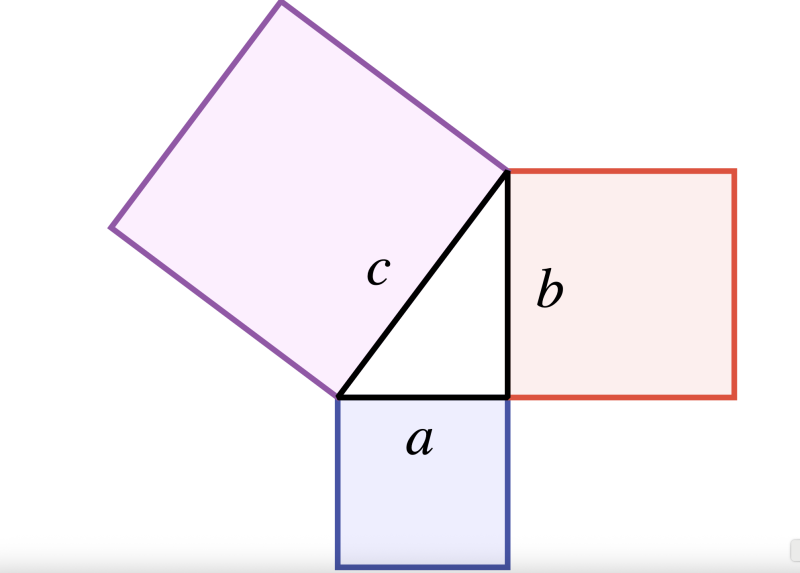
Pardon's work falls into what many feel is the friendliest area of mathematics: geometry. At school most of us will have drawn geometric shapes on pieces of paper. With these visual aids it is possible to see what some of the mathematical results we learn about, such as Pythagoras theorem, actually mean.
But flat geometry isn't the only geometry. Our planet, for example, is spherical. Standard school geometry (known as Euclidean geometry) doesn't work on a sphere. For example, the angles of a triangle don't add up to 180 degrees. This might sound alarming — architects use Euclidean geometry to build houses — but actually it's fine. We humans are so small compared to the size of the Earth that we don't notice its curvature. Locally, the Earth looks like the flat plane, so for local purposes, such as building houses, Euclidean geometry works perfectly well.
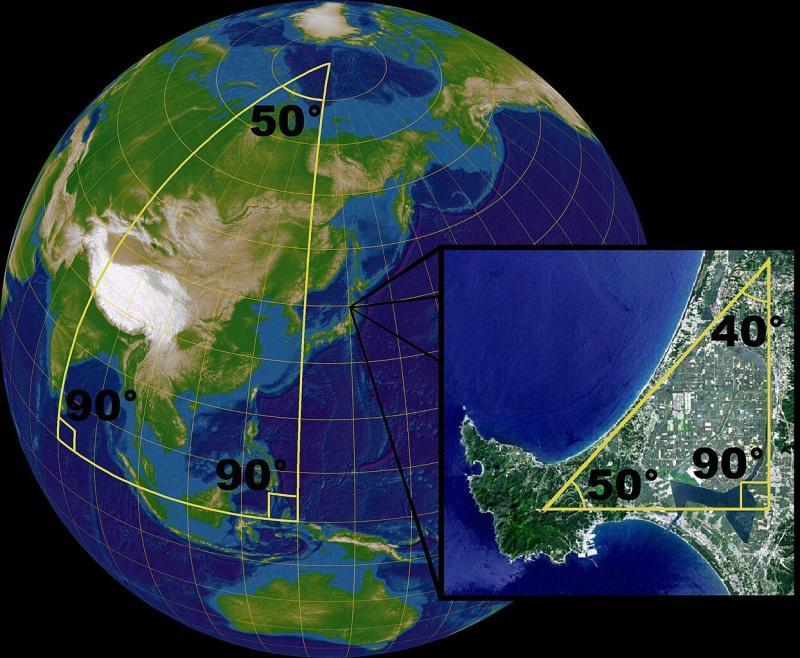
The sphere is what mathematicians call a manifold - a surface that locally looks like the Euclidean plane. This notion can be made mathematically precise and it helps you transfer geometric intuition from Euclidean geometry to the object you're dealing with.
The sphere is a two-dimensional manifold (it's a surface). Other examples of two-dimensional manifolds are a cylinder and the surface of a doughnut (technically known as a torus). There are also three-dimensional manifolds: these are shapes that locally look like the standard three-dimensional space. And because mathematicians have a way of thinking about higher-dimensional spaces in precise terms, there are also higher-dimensional manifolds.
An infinity of shapes
Even just sticking to two-dimensional manifolds, it turns out that there's a vast multitude of them. You only need to look around your room to see lots and lots of differently shaped surfaces. When mathematicians come across such an infinite zoo of different objects, they have an urge to classify them: to sort them into buckets so that all the objects in one bucket are similar in some fundamental way.
We can again take the Earth as an example. It's not flat, but it's also not perfectly spherical. It has mountain ranges that stick out and it's flattened at the poles. It would be unfair, however, to call it fundamentally un-spherical, so we might want to put it in the same bucket as the perfect sphere.
Would a doughnut shape also go into that bucket? Probably not. Unlike the Earth and the sphere, it has a hole. Indeed, topology — a more lenient version of geometry — classifies certain types of surfaces according to the number of holes they have. Surfaces with no holes go into one bucket, surfaces with two holes in the next bucket, and so on (find out more here).

In this context the number of holes is an example of an invariant: it doesn't change when you deform a shape in a manner you deem to be allowed. Generally, invariants are a great classification tool. When you have a huge or infinite number of objects and a notion of an invariant, then you can put all the objects for which the invariant takes the same value into the same bucket.
Counting curves
One important result that x is being honoured for also involves invariants, in this case of manifolds that arise in what is called symplectic geometry (find out more here). The manifolds in question are called Calabi–Yau 3-folds. The invariants in this case come from counting curves you can define on these shapes.
The problem was, however, that there were two different ways of defining, and of counting, such curves. One of them was developed by Mikhael Gromov, who won a prestigious Abel Prize in 2009, and Edward Witten, who in 1990 became the first physicist to be awarded a Fields Medal. The other was developed by Simon Donaldson, who won a Fields Medal in 1986, and Richard Thomas, who has won a number of prestigious prizes and as an invited speaker at the 2010 ICM.
Both ways of counting had been developed by the late 1990s and a few years later four mathematicians — Davesh Maulik, Nikita Nekrasov, Andrei Okounkov, and Rahul Pandharipande — conjectured that they were actually equivalent.
This so-called MNOP conjecture remained open for twenty years until in 2023 it was finally proved by Pardon, to huge acclaim.
A link to physics
So far, so pure mathematics. If you can appreciate mathematicians' passion for abstract shapes, then you can appreciate why someone who solves an important and difficult question in the field should win an important prize (and besides, the MNOP conjecture is just one aspect of Pardon's work).
But there is more. Since the early twentieth century, physicists have been grappling with a fundamental conundrum: the best theory they have for describing the world at large scales (which is due to Albert Einstein) does not get along with the theory that describes the world at tiny scales (quantum physics). You can find out more here. What physicists would like, however, is one unified theory that describes everything.
One candidate for such a theory is called string theory. We don't have experimental evidence that string theory is correct, but it does solve the mathematical problems that arise when you naively try to put Einstein's theory in the same framework as quantum physics.
One rather odd prediction of string theory is that there are more than three dimensions of space. We can't see those dimensions because they are rolled up very small. To understand such a world you need to think of strange geometric shapes that can harbour it. Calabi-Yau manifolds are an example of this type of shape. And Calabi-Yau 3-folds, involved in the MNOP conjecture, provide a model for the Universe in a version of string theory called superstring theory. This explains the role of a physicist — Edward Witten — in the mathematics mentioned above.
Pardon himself is a pure mathematician, not a physicist. He has worked in geometry and topology, and also in knot theory. As the Fields Medal citation puts it, "Pardon is a mathematician of extraordinary depth and originality, who has repeatedly had a significant impact on the fields of topology and symplectic geometry. He has both contributed to fundamental structure and solved problems that had stymied the community for decades."
The fact that his work has relevance to physics is an example of the "unreasonable effectiveness" of mathematics when it comes to describing the real world.
About this article
Marianne Freiberger is Editor of Plus.
This content was produced as part of the collaboration between plus.maths.org and the London Mathematical Society and with kind support of the Institute of Mathematics and its Applications.