Article

Freedom and physics

Most of us think that we have the capacity to act freely. Our sense of morality, our legal system, our whole culture is based on the idea that there is such a thing as free will. It's embarrassing then that classical physics seems to tell a different story. And what does quantum theory have to say about free will?
News story
icon

Happy 70th birthday Stephen Hawking!

"Astronomers are used to large numbers, but few are as large as the odds I'd have given this celebration today," is how Astronomer Royal Martin Rees started his presentation at Stephen Hawking's birthday symposium yesterday. He was talking about the 1960s when he first met Hawking who was then already suffering motor neurone disease. But Rees' prediction has been proved wrong. Hawking turned 70 yesterday and since the time of their first meeting he has made enormous contributions to cosmology and physics.
News story

Gut logic

Human reasoning is biased and illogical. At least that's what a huge body of psychological research seems to show. But now a psychological scientist from the University of Toulouse in France has come up with a new theory: that logical and probabilistic thinking is an intuitive part of decision making, only its conclusions often lose out to heuristic considerations.
News story
Higgs boson

Hooray for Higgs!

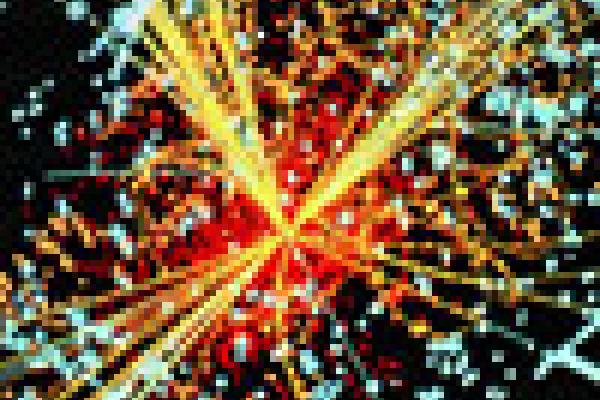
"It's a great day for particle physics," says Ben Allanach, a theoretical physicist at the University of Cambridge. "It's very exciting, I think we're on the verge of the Higgs discovery." And indeed, it seems like the Large Hadron Collider at CERN has given particle physics an early Christmas present — compelling evidence that the famous Higgs boson exists.

News story

Spooky action found in gases

Researchers in Germany have created a rare example of a weird phenomenon predicted by quantum mechanics: quantum entanglement, or as Einstein called it, "spooky action at a distance". The idea, loosely speaking, is that particles which have once interacted physically remain linked to each other even when they're moved apart and seem to affect each other instantaneously.
News story

Diffusion plays by the rules

Whenever you smell the lovely smell of fresh coffee or drop a tea bag into hot water you're benefiting from diffusion: the fact that particles moving at random under the influence of thermal energy spread themselves around. It's this process that wafts coffee particles towards your nose and allows the tea to spread around the water. Diffusion underlies a huge number of processes and it has been studied intensively for over 150 years. Yet it wasn't until very recently that one of the most important assumptions of the underlying theory was confirmed in an experiment.
Article

Maths behind the rainbow

Keats complained that a mathematical explanation of rainbows robs them of their magic, conquering "all mysteries by rule and line". But rainbow geometry is just as elegant as the rainbows themselves.

News story
icon

Join the celebration of mind!

It's 21st of October and for puzzle lovers this can only mean one thing: the G4G Celebration of mind. This annual party celebrates the legacy of Martin Gardner, magician, writer and father of recreational maths, with mathemagical events in his honour happening all over the world.
News story

Born to count?

People as well as animals are born with a sense for numbers. But is this inborn number sense related to mathematical ability? A new study suggests that it is.
Article
hourglass with clock behind

What is time?

Everyone knows what time is. We can practically feel it ticking away, marching on in the same direction with horrifying regularity. Time has enslaved the Western world and become our most precious commodity. Turn it over to the physicists however, and it begins to morph, twist and even crumble away. So what is time exactly?
News story

Stretch, but without the wrinkles

A team of nanoengineers have constructed new materials that don't wrinkle when you stretch them. This makes them similar to tissue found in the human body, so they may in the future be used to repair damaged heart walls, blood vessels and skin.