Marianne Freiberger

Marianne Freiberger

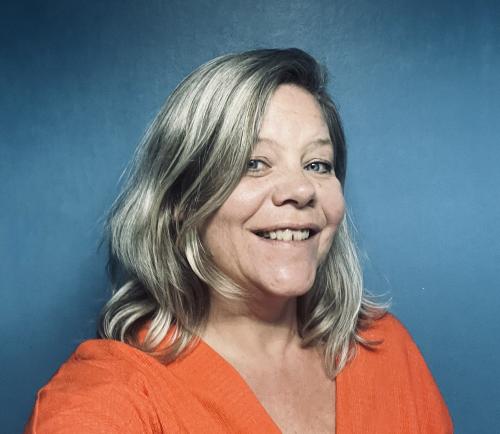
Marianne Freiberger is Editor of Plus. She joined Plus in 2005 after doing a PhD and then a three year postdoc at Queen Mary, University of London. As a researcher she worked in complex dynamics, the area of pure maths that has given us the Mandelbrot set. In the world of maths communication she has been Editor-in-Chief of the Mathscareers website, given presentations to mathematicians about how to communicate their work to a wider audience, and to journalists about how to deal with maths in the media. She has been a TEDx speaker and an invited speaker at the International Congress of Mathematicians in 2010.

Together with Rachel Thomas, Marianne has co-authored several popular maths books including Numericon: A journey through the hidden lives of numbers and Understanding numbers, and were editors on the book 50: visions of mathematics. They were Science Editors for the Discovery+ documentary series Universe Unravelled about the work of the Stephen Hawking Centre for Theoretical Cosmology. 

In October 2022 Marianne and Rachel received a SPI-M-O Award for Modelling and Data Support (SAMDS) from the UK's Scientific Advisory Group for Emergencies. This award recognised their work with the JUNIPER modelling consortium to provide a wide audience (including public, press, policy makers and government) with clear and accessible explanations of some of the maths that was vital in responding to the COVID-19 pandemic.


Article

Information: Baby steps

If I tell you that it's Monday today, then you know it's not any of the other six days of the week. Perhaps the information content of my statement should be measured in terms of the number of all the other possibilities it excludes? Back in the 1920s this consideration led to a very simple formula to measure information.
Article

Information is sophistication

Kolmogorov complexity gives a high value to strings of symbols that are essentially random. But isn't randomness essentially meaningless? Should a measure of information assign a low value to it? The concept of sophistication addresses this question.
Article

Information is surprise

If I tell you something you already know, then that's not very informative. So perhaps information should be measured in terms of unexpectedness, or surprise?

Article

Information is complexity

There are many ways of saying the same thing — you can use many words, or few. Perhaps information should be measured in terms of the shortest way of expressing it? In the 1960s this idea led to a measure of information called Kolmogorov complexity.
Article

Information is noisy

When you transmit information long-distance there is always a chance that some of it gets mangled and arrives at the other end corrupted. Luckily, there are clever ways of encoding information which ensure a tiny error rate, even when your communication channel is prone to errors.
Article

Information is bits

Computers represent information using bits — that's 0s and 1s. It turns out that Claude Shannon's entropy, a measure of information invented long before computers became mainstream, measures the minimal number of bits you need to encode a piece of information.
Article

Introducing the Klein bottle

A Klein bottle can't hold any liquid because it doesn't have an inside. How do you construct this strange thing and why would you want to?
News story

23 and maths

The company 23andMe made headlines by launching its DNA testing service in the UK. But how are the risks of developing a disease calculated?