The Fields Medals 2026: Jacob Tsimerman
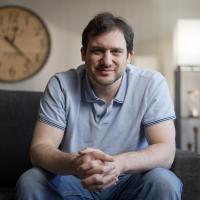
Jacob Tsimerman, a mathematician at the University of Toronto, has won one of this year's Fields Medals at the International Congress of Mathematicians (ICM). The Fields Medals is one of the most prestigious prizes in mathematics. It is awarded every four years "to recognise outstanding mathematical achievement for existing work and for the promise of future achievement".
"It's useful to think of number theory as a collection of problems ... Number theorists are great at asking rich questions – Fermat's last theorem for example," Jacob Tsimerman says. "But whenever you actually want to solve something you need to delve into combinatorics, or analysis, or geometry… so number theorists are the pickpockets of mathematics."
Tsimerman has been recognised for being one of the best, lifting a technique originally developed in mathematical logic and using it to solve long standing problems from number theory that lie in the area of algebraic geometry.
Number theorists and pickpockets
Fermat's last theorem is an example of what many number theorists do, trying to find whole number solutions to polynomial equations. Fermat's last theorem says there are no whole numbers $x,y$ and $z$ that make the following equation true:
$$x^n+y^n=z^n$$
for any whole number $n$ that is greater than 2. This statement might look simple but proving it took hundreds of years and stimulated new areas of mathematical research. (You can find out more in this collection of articles, videos and podcasts, featuring the mathematician, Andrew Wiles, who proved Fermat's last theorem.)
The equation at the heart of that theorem probably looks familiar. That's because when $n=2$ (a case not included in the theorem) it is the equation for a circle with a radius of length $z$:
$$x^2+y^2=z^2$$.
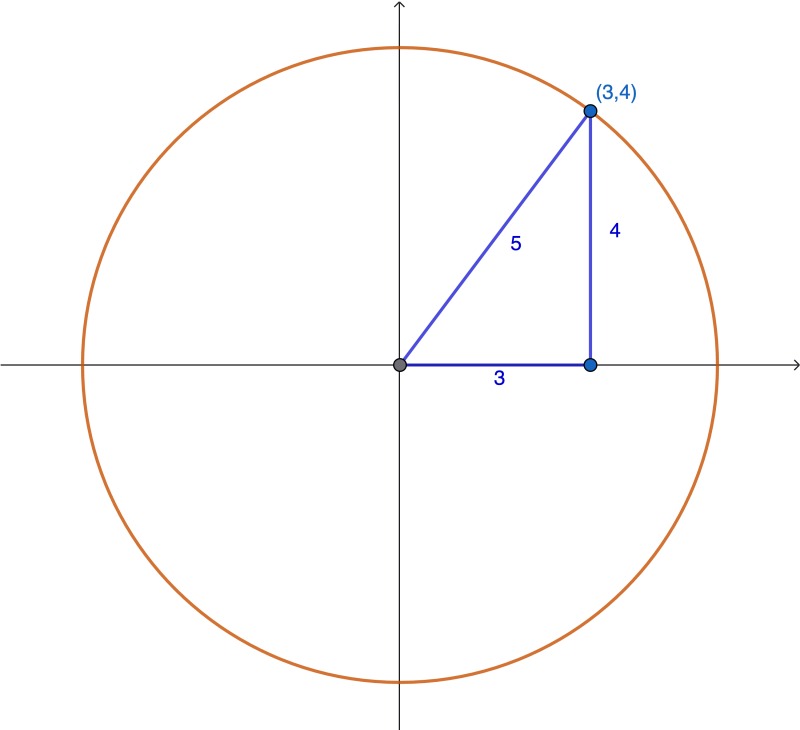
We know there are whole number solutions to this equation, such as
$$3^2+4^2=5^2$$
which can be seen as a point lying on a circle with radius 5. Whole number solutions are called Pythagorean triples and are surprisingly tricky to find (you can read more here). "One of the main tricks is, even though it's hard to find solutions in the whole numbers, it's easy to find solutions in real numbers," says Tsimerman. "You just draw a circle."
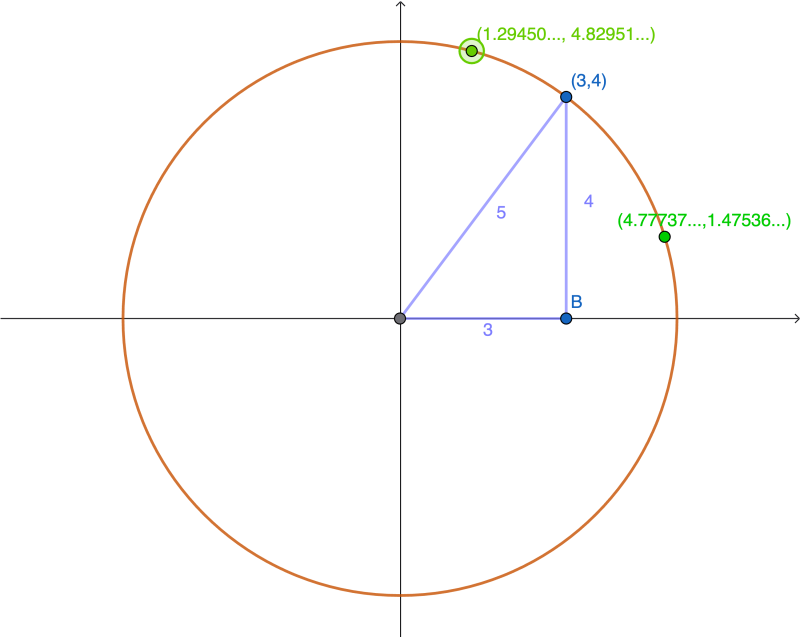
As well as finding real number solutions, thinking about the shape described by the equation you are interested in places you in the area of mathematics called algebraic geometry. And your work as a mathematical pickpocket can begin.
"It's easy to think about a circle in many ways," says Tsimerman. If you are willing to stretch the circle and instead think of its shape as a loop, you can access the tools of topology. If you instead keep the circle rigid and think about what shapes you can fit through it, how big it is, and what tension it holds, that is heading towards the areas of differential or Riemannian geometry. And if you can examine the behaviour of functions on the circle, that's analysis.
"That's the way these other fields enter number theory. Number theory asks for solutions in whole numbers, which is hard. But the equations are easy to study by looking at the solutions over real or complex numbers, and looking at their shape, their geometry, their topology," says Tsimerman.
"It's a wonderful coincidence of our world that things tend to be more beautiful than we have any right to expect. There's all these results that say the topology and the geometry and the shapes tell you a lot about the number theoretic picture as well."
The simplest tool for the job: o-minimality
Polynomials, like the equation of a circle, are the simplest functions you can write. Number theory may often start with questions about polynomials but when you are drawing on these different areas of mathematics things can get much more complicated.
"Sometimes you want to take the anti-derivative of some function, like $1/(x^2+1)$, and then you get trigonometry, log and exponential functions popping up," says Tsimerman. (For those curious, the anti-derivative of $1/(x^2+1)$ is $\arctan(x)$ plus some constant.) The functions that arise as a result can be more complicated, with infinite oscillations (like the sine function from trigonometry) or whose graphs are infinitely long. "There's the Peano space filling curves that even though they're lines, they can fill up an entire square. There's all these weird things that can occur."
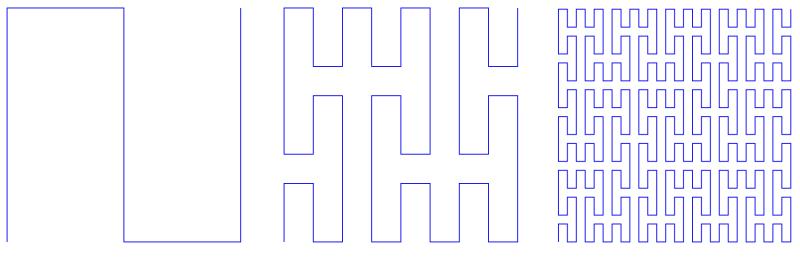
In order to understand these more complicated functions and the shapes they describe mathematicians needed a way to tame their wild behaviour. "And in maths, like in many other things, you want to find the simplest tool for the job," says Tsimerman. "You want to find a category of functions, sort of a world to play with, which is rich enough to give you the certain specific functions you want. But it's still tame enough that it doesn't have these super weird behaviours."
The right tool for the job comes from the area of mathematical logic. O-minimality (the "o" stands for "ordered") has been used in many areas of mathematics, including geometry, and has been studied for many decades. Essentially a shape is o-minimal if any straight line intersects the shape in finitely many points and intervals. "It makes precise the notion of what a tame geometry is," says Tsimerman.
One of the results Tsimerman is recognised for is his work with Benjamin Bakker and Yohan Brunebarbe to show that Hodge theory, an approach used extensively in number theory and arithmetic geometry, lives in this o-minimal world. This provided a proof of Griffiths' conjecture, proposed by Phillip Griffiths at the ICM held in Nice in 1970. (You can read more about Hodge theory and the work of Griffith in our interview with him when he won the Chern medal at the 2014 ICM in Seoul.) "This was one of the problems that Griffiths sketched out and explained how he thought things should work," says Tsimerman. "[Our proof] finishes one of the stories he started but he's been involved in many stories." The Fields Medal recognises Tsimerman's significant role in finishing several other mathematical stories as well.
Being stuck and building intuition
"When I was starting to be a mathematician I thought theorems were what the cool kids do. Working in general was the way to go," says Tsimerman. "Examples are for the weak! I never want to write down a number in my whole life, only variables!"
Today, Tsimerman explains, his mathematical intuition rests on the huge repository of examples which gives him a way to access new problems, like those he works on with his students. "Constructing these toy cases are really the moments that are the most alive for me."
Acquiring this kind of mathematical experience is only possible by embracing the moments you are stuck. And Tsimerman says that, like most mathematicians, he is stuck a lot of the time. "This is a cliche, but I'm constantly failing at everything and then the things I end up working on are the little bits of success that slip through the cracks." If you ask him what he's working on, he says he'll reply that he is working on, say, 20 problems, and he's stuck on all of them. "It really is the truth, every mathematician will tell you the same thing."
Tsimerman explains the secret is to appreciate the efforts you make along the way: "You have to work really hard in math to make subgoals and get satisfaction from less than success." Even if an approach hasn't been successful, it is still an opportunity to learn. "I think the most illuminating moments are when something doesn't work," says Tsimerman. "A day where I tried an idea and failed, I think of as a good day."
About this article
Rachel Thomas is Editor of Plus. She interviewed Tsimerman in July 2026 in the run-up to the ICM.
This content was produced as part of the collaboration between plus.maths.org and the London Mathematical Society and with kind support of the Institute of Mathematics and its Applications.