
The Fields Medals 2026: Yu Deng
Yu Deng, a mathematician at the University of Chicago, has won one of this year's Fields Medals at the International Congress of Mathematicians. The Fields Medal is one of the most prestigious prizes in mathematics. It is awarded every four years "to recognise outstanding mathematical achievement for existing work and for the promise of future achievement".
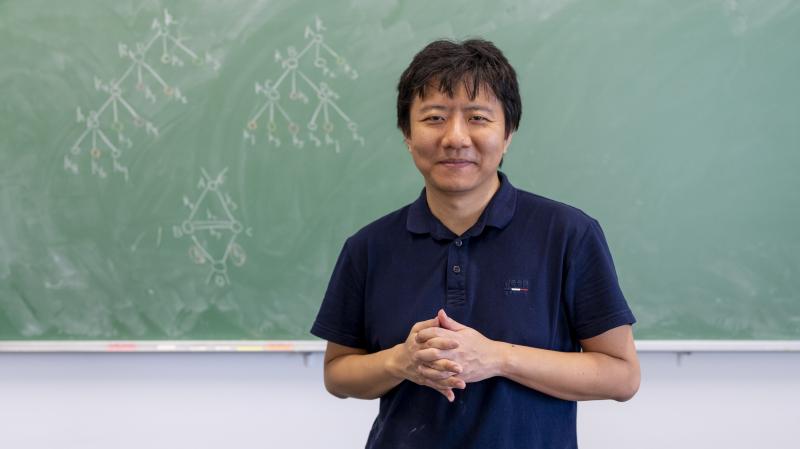
"I'm very, very happy — not just for myself but also because the field I am working on is getting this significant recognition," says Yu Deng. The field he is referring to is the study of partial differential equations. Loosely speaking, these are equations that describe how things change. And because nature is characterised by change — things grow, flow, shrink, and stretch — they are equations that often find use in physics.
Hilbert's grand vision
The roots of some of Yu Deng's work can be traced back to 1900 when the second-ever International Congress of Mathematicians took place in Paris. David Hilbert, one of the greatest mathematicians of the time, was there too and he took to the stage on August 8. He proceeded to present ten mathematical problems he thought showed just "how rich, how manifold and how extensive mathematical science" was at the time. Later on, he extended the lofty list to include a total of 23 problems.
Hilbert's problems were all unsolved at the time and set the agenda for no small part of the maths that has been done since. One of them, the sixth, was particularly fundamental. The idea was to make sure that physics, which is described in the language of mathematics, should be based on a number of clearly defined axioms. Every physical theory should be derivable, step-by-step by means of logic, from those few basic premises.
It was a high bar and Hilbert later went on to be more precise. One of the issues he singled out was how you get from describing the world at very small scales — where zillions of atoms and molecules zoom about and bump into each other — to descriptions at larger scales. This particularly pertains to liquids and gases. Any equation that captures, for example, the temperature, pressure and velocity of a fluid should ultimately be derived from the physics that describes the behaviour of the individual particles that make it up.
For mathematicians there are three major stepping stones on this route from small to large. At the microscopic level, Newton's laws of motion describe the behaviour of individual particles, thought of as tiny billiard balls. But because it's hard to keep track of the vast number of particles that make up a liquid or gas, the mesoscopic scale looks at the bulk statistical behaviour of particles. At this scale the Boltzmann equation, named after the nineteenth century mathematician Ludwig Boltzmann, helps describe properties like temperature or velocity in terms of averages. Finally, at the macroscopic scale, the Navier-Stokes and the Euler equations describe a fluid as we experience it — a continuous substance — without reference to individual particles at all.
A problem of two steps
Addressing Hilbert's sixth problem means deriving Boltzmann's equations from Newton's laws and deriving the Navier-Stokes and Euler equations from Botzmann's equations.
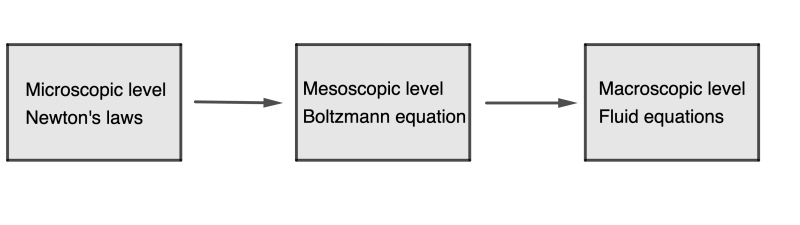
Hilbert himself contributed to the second step, and more recent developments have meant that this step is now well understood.
The first step, going from the microscopic to the mesoscopic level, proved harder. A first breakthrough came in 1975, when the mathematician Oscar Lanford managed to derive the Boltzmann equation from the laws of physics that act at the microscopic level. (The general idea in this kind of work is to imagine that there is some number N of particles, each with a diameter r. You then let the number N tend to infinity, while the radius r tends to zero, and see what happens to the mathematics in the limit, making sure you impose the "right" kind of conditions on this process. See here for a technical explanation).
The problem with Lanford's result was that it only worked for what mathematicians vaguely refer to as "sufficiently short times". Loosely speaking, this means that you have only just pressed "play" on the system of many particles that you are trying to describe, so particles haven't yet had much time to collide with each other. "Each particle has only had a tiny number of collisions — only one in a million particles is expected to have had one collision," explains Yu Deng.
Subsequent results suffered from similar limitations. The main sticking point was down to the fact that collisions between particles were represented by individual terms in a long sum: there'd be one term in the sum representing zero collisions, one term representing two collisions, one term representing three collisions, and so on (in technical terms, the sums were power series).
Naively, if you add together more and more terms, the result should get larger and larger. But that's not always the case: if the terms you are adding get progressively smaller fast enough, then even an infinite sum can converge to a finite result. However, the convergence only happens under specific conditions, and if these conditions are too restrictive, then you end up with a result that only applies in specific circumstances.
From one big step to many small steps
Yu Deng entered the picture in the late 2010s, but he came from a very different direction. "[Together with Zaher Hani] we had been working on wave turbulence, which has to do with the interaction between waves, [rather than interaction between particles]," he explains. "Then, through talking to people, we realised that there was this long-standing problem [of Hilbert's] and that our methods could be applied to it."
Yu Deng and Hani invited a newly graduated student, Xiao Ma, into their project and did what most mathematicians would do when confronted with something that's too big to handle: they divided a long time interval up into lots of small ones. The collisions that particles can experience can be pictorially represented by handy diagrams (not unlike the famous Feynman diagrams), but these diagrams at first sight refuse to play ball. "[The division of a long time interval] will cause the diagrams to get infinitely more complicated — so you need a new framework and new tools to analyse these diagrams."
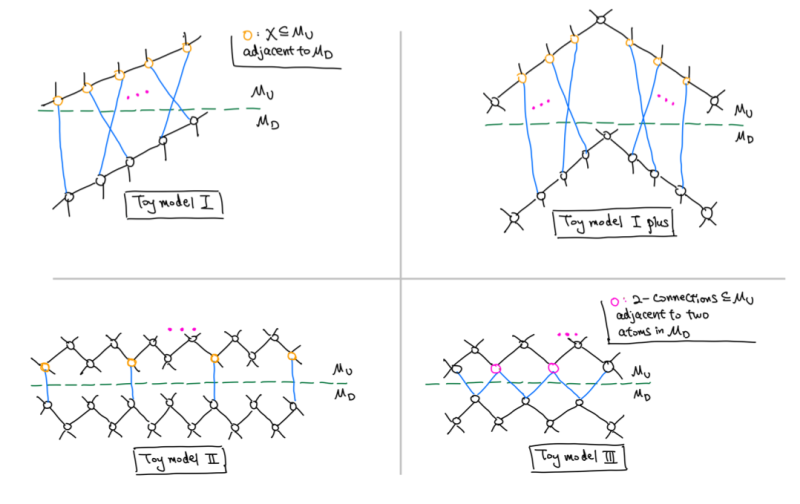
This is exactly what Yu Deng, Hani and Ma managed to provide and by 2025 they had solved the problem: they had derived the Boltzmann equation from what is called hard sphere dynamics, a name that alludes to the fact particles are treated as little hard spheres (technical terms and conditions apply, see the team's paper for details).
According to the Fields Medal citation, the "work is a leap forward in a centuries-long quest by mathematicians and physicists to derive the basic laws of physics from first principles."
In a second piece of work, Yu Deng, Hani and Ma also worked out how to fit their result on deriving mesoscopic level physics from microscopic level physics with the previous results on deriving macroscopic physics from mesoscopic level physics. "This requires some technical [work] so we still wrote around 40 pages for that," he says. "But it's not too difficult." Their work, they claim, completes the entire pipeline from microscopic to macroscopic, as was demanded by Hilbert.
Six - tick?
Yu Deng's work is theoretical in nature — people involved with building planes, cars, or ships, or other areas where an understanding of fluids is important will (for now) continue to use tried and tested methods from computatio/nal fluid dynamics. "But there have been thoughts that going back to the basics may [provide] some help on how we view things like the Boltzmann equation," says Yu Deng. "These things we still have to understand."
As for Hilbert's grand dream of axiomatising all of physics, Yu Deng thinks we're nowhere near yet. "There is so much physics and so much maths. The only thing we can do is look at specific problems. Maybe one day we will see that they have something in common."
For now, Yu Deng's work helps to show that the surprisingly fruitful interaction between maths and physics is still on solid ground. Other work mentioned in his Fields Medal citation includes "the derivation of wave kinetic equations from nonlinear dispersive systems, and probabilistic approaches to nonlinear Schrödinger dynamics."
Together with the work of the other three 2026 Fields Medallists, Yu Deng's research shows that maths is still as rich, manifold, and extensive as it was when Hilbert challenged the world with his 23 problems. Perhaps the sixth can be considered ticked off.
Marianne Freiberger is Editor of Plus. She interviewed Yu Deng in the run-up to the ICM 2026.
This content was produced as part of the collaboration between plus.maths.org and the London Mathematical Society and with kind support of the Institute of Mathematics and its Applications.