
The Fields Medals 2026: Hong Wang
Hong Wang, a mathematician at the NYU Courant and the Institut des Hautes Études Scientifiques, has won one of this year's Fields Medals at the International Congress of Mathematicians (ICM). The Fields Medal is one of the most prestigious prizes in mathematics. It is awarded every four years "to recognise outstanding mathematical achievement for existing work and for the promise of future achievement".
What do sound waves, snow flakes and spinning needles have in common? The answer is the mathematics of Hong Wang, who was awarded the Fields Medal at the 2026 ICM, for her work in harmonic analysis and geometric measure theory.

Sound waves
One of the most remarkable tools in mathematics – Fourier analysis – can break down any sound wave, no matter how strange, into a sum of simpler, regularly repeating waves (known as sine waves). This discovery by Joseph Fourier in the 19th century is the basis for many technologies like MP3 audio compression and voice recognition.
Fourier analysis has proved invaluable across mathematics, allowing many mathematical functions to be expressed in terms of these simpler functions. If you can express your complicated mathematical problem in terms of much simpler problems, then solving the difficult problem becomes potentially a much easier task. (You can read a basic introduction to the maths here and a mostly maths-free example of its use here.)
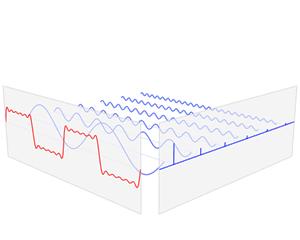
Fourier first developed this technique to mathematically understand how heat flows through objects, and it is used widely in applications such as image analysis, mathematical physics, and economics. Harmonic analysis generalised this approach to much broader mathematical questions, many of which remain unanswered. "There are still a lot of unsolved problems and phenomena we hope to understand better," says Wang.
Snow flakes
Wang is also recognised for her work in geometric measure theory. The tools mathematicians usually use to understand the geometry of shapes rely on calculus but these only work on smooth surfaces. But these tools fail to work on some shapes, even familiar shapes like intersecting soap bubbles. Instead geometric measure theory uses ideas from measure theory (which formalises the ideas of length, area and volume – see here for an introduction) to understand the geometry of shapes that are not smooth.
One of the important concepts in this area is the Hausdorff dimension which considers how the measure of an object scales with its size (measure here is the generalisation of length, area, volume, etcetera). Where the usual rules apply the measure behaves as you'd expect and scales with the dimension of the object: you double the sides of a square, you increase the length of the square's one-dimensional perimeter by 21, and the the area of the squares' two-dimensional area increases by 22. But the rules break down for complicated shapes like fractals.
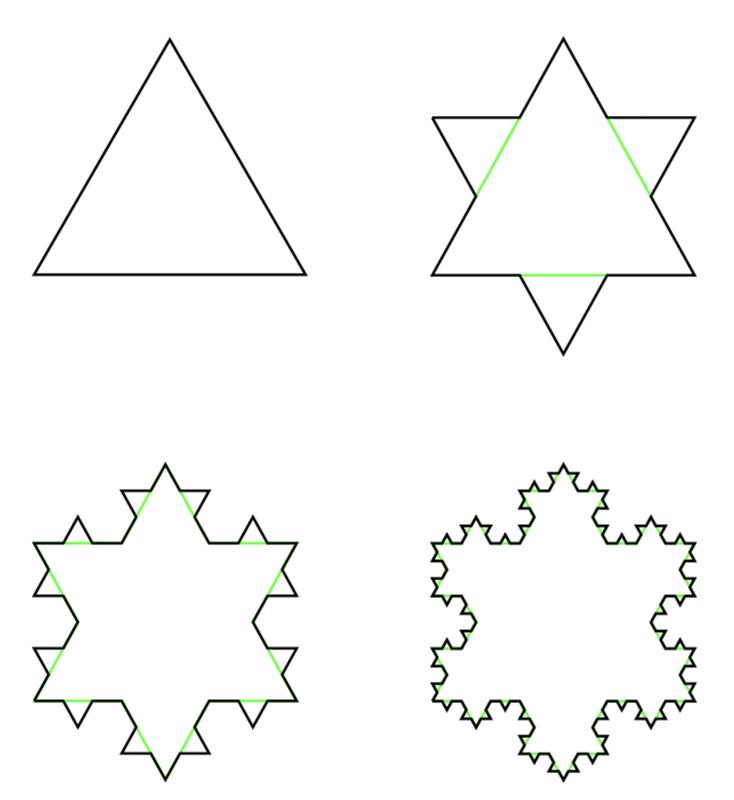
You can see this in action in the famous fractal curve called the Koch snowflake. This is created by starting with an equilateral triangle and repeatedly replacing the middle third of any line segment with a tent made by two sides of a smaller equilateral triangle. Through this process you can make the one-dimensional border of the snowflake infinitely long, but it stays confined within a finite area. The length of this fractal curve is clearly growing very differently to the perimeter of a square, information that is described by its Hausdorff dimension of 1.26. (You can see how this is calculated in this introduction to the Hausdorff dimension.)
Spinning needles
The areas of harmonic analysis and geometric measure theory meet in something called the Kakeya needle problem. In 1917 Sōichi Kakeya asked the question: what is the minimum area needed to spin a needle so that it can point in every possible direction? You might immediately think of a circle but Kakeya had already come up with a smaller possibility: a triangle with inwardly bending sides (a deltoid).
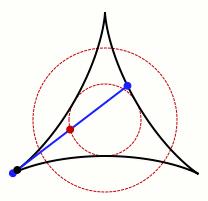
A space in which you can spin a needle in this way became known as a Kakeya set. Just two years after Kakeya defined them Abram Besicovitch came up with an ingenious way to construct one: sliding and then ever-so-slightly twisting the needle to produce a fractal-like branching shape. And astonishingly, you can make the area of this Kakeya set as small as you want. A similar process could be used for constructing an arbitrarily small Kakeya set that allws you to spin the the needle in three dimensions.
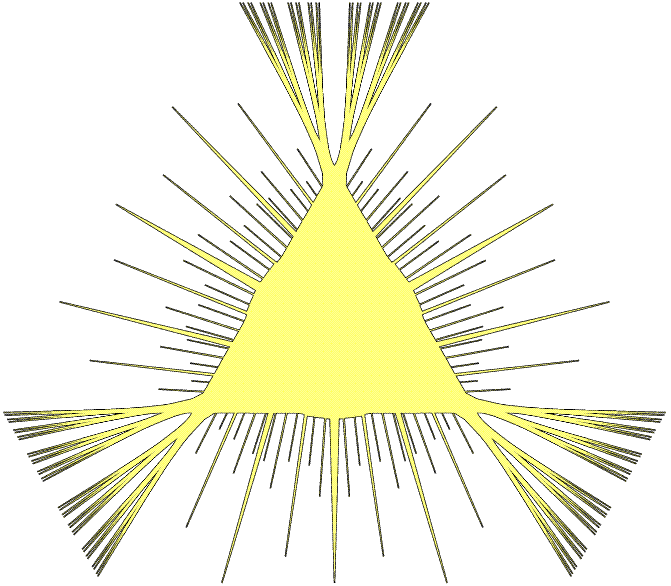

A space essentially having zero size that still allows you to spin a needle in all directions might seem impossible but geometric measure theory suggested an explanation: the Hausdorff dimensions of these Kakeya sets must be as big as possible. This became known as the Kakeya conjecture and was proved true in two dimensions in 1971 by Roy Davies in just a few pages. But it remained unanswered in any higher dimensions until Wang and her colleague Joshua Zahl proved the three-dimensional case in 2025.
"I got interested in the Kakeya problem from Fourier analysis," says Wang. In the 1970s Charles Fefferman had shown that Kakeya sets were key to solving problems in fourier analysis in three dimensions. Wang was particularly interested in functions that could be decomposed into waves, where each of these waves lives in a long thin tube leaving a sphere and pointing in every different direction (an area of Fourier analysis called restriction theory). "In order to understand these functions one needs to understand the underlying geometry [of these long, thin tubes], which is a Kakeya set," says Wang. "One reason I found the kakeya set intriguing is that it independently appeared in different areas, where people were trying to study different phenomena. Those surprising connections are fascinating."
Proving the Kakeya conjecture is true in three dimensions provides foundational strength to many results in harmonic analysis. "In Fourier analysis we have a tower of conjectures," says Wang. "The Kakeya conjecture lies at the bottom of three other conjectures, one implying the other. If you disprove the Kakeya conjecture, then you disprove the whole tower of conjectures." The fact that Wang and Zahl could prove the three-dimensional case adds weight to the other conjectures in three dimensions also being true, with their proof providing insights to attacking the other conjectures in the tower. (You can read more in this excellent Quanta article.)
Wang has been awarded the Fields medal for this and her many other contributions to these areas. She has worked with many different collaborators, an aspect of her work as a mathematician that she particularly enjoys. Wang also highlighted the importance of her time as a PhD student at MIT, and her supervisor Larry Guth: "I learned from him how to think about math, how to organise myself… I think this training was not just helpful in math, but it's also helpful in life too."
About this article
Rachel Thomas is Editor of Plus. She interviewed Hong Wang in July 2026 in the run-up to the ICM.
This content was produced as part of the collaboration between plus.maths.org and the London Mathematical Society and with kind support of the Institute of Mathematics and its Applications.