Content about “
mathematical reality

Article

Bang, crunch, freeze and the multiverse

Some of the things I overheard at Stephen Hawking's 70th birthday conference did make me wonder whether I hadn't got the wrong building and stumbled in on a sci-fi convention. "The state of the multiverse". "The Universe is simple but strange". "The future for intelligent life is potentially infinite". And — excuse me — "the Big Bang was just the decay of our parent vacuum"?!
Podcast

Bang, crunch, freeze and the multiverse

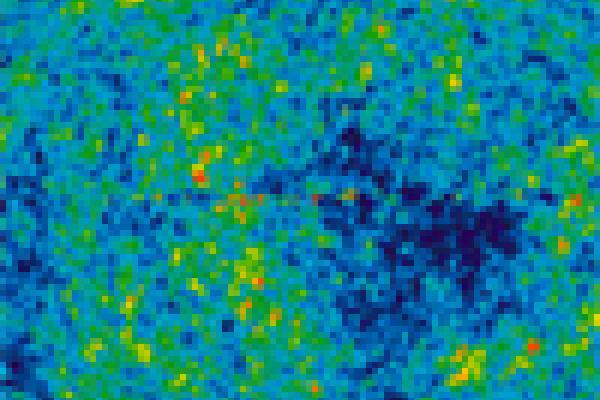
What's a multiverse? What's the future for intelligent life? And what happened 380,000 after the Big Bang. Find out in these interviews with the physicists David Spergel and Raphael Bousso, who we spoke to during Stephen Hawking's 70th birthday conference.
Podcast

Supergravity to the rescue?

This is one of our podcasts from Stephen Hawking's 70th birthday conference, which took place in January 2012 in Cambridge. Rachel Thomas talks to Renata Kallosh from Stanford University about a theory that promises to unite the physics of the very small — quantum physics — and the physics of the very large — Einstein's theory of gravity.
Article

Free, from top to bottom?

A traditional view of science holds that every system — including ourselves — is no more than the sum of its parts. To understand it, all you have to do is take it apart and see what's happening to the smallest constituents. But the mathematician and cosmologist George Ellis disagrees. He believes that complexity can arise from simple components and physical effects can have non-physical causes, opening a door for our free will to make a difference in a physical world.
Article

Freedom and physics

Most of us think that we have the capacity to act freely. Our sense of morality, our legal system, our whole culture is based on the idea that there is such a thing as free will. It's embarrassing then that classical physics seems to tell a different story. And what does quantum theory have to say about free will?
Podcast

Happy 70th birthday Stephen Hawking!

"Astronomers are used to large numbers, but few are as large as the odds I'd have given this celebration today," is how Astronomer Royal Martin Rees started his presentation at Stephen Hawking's birthday symposium yesterday. He was talking about the 1960s when he first met Hawking who was then already suffering motor neurone disease. But Rees' prediction has been proved wrong. Hawking turned 70 yesterday and since the time of their first meeting he has made enormous contributions to cosmology and physics.
Article
icon

John Conway - discovering free will (part II)

In this, the second part of our interview, John Conway explains how the Kochen-Specker Theorem from 1965 not only seemed to explain the EPR Paradox, it also provided the first hint of Conway and Kochen's Free Will Theorem.
Article
icon

John Conway – discovering free will (part I)

On August 19, 2004, John Conway was standing with his friend Simon Kochen at the blackboard in Kochen’s office in Princeton. They had been trying to understand a thought experiment involving quantum physics and relativity. What they discovered, and how they described it, created one of the most controversial theorems of their careers: The Free Will Theorem.