Content about “ fractal
”
ART+MATH=X
Maths and art: the whistlestop tour
Many people find no beauty and pleasure in maths - but, as Lewis Dartnell explains, our brains have evolved to take pleasure in rhythm, structure and pattern. Since these topics are fundamentally mathematical, it should be no surprise that mathematical methods can illuminate our aesthetic sense.
How big is the Milky Way?
A question which has been vexing astronomers for a long time is whether the forces of attraction between stars and galaxies will eventually result in the universe collapsing back into a single point, or whether it will expand forever with the distances between stars and galaxies growing ever larger. Toby O'Neil describes how the mathematical theory of dimension gives us a way of approaching the question.
Measure for measure
Fractal expressionism
In the late 1940s, American painter Jackson Pollock dripped paint from a can on to vast canvases rolled out across the floor of his barn. Richard P. Taylor explains that Pollock's patterns are really fractals - the fingerprint of Nature.
Computing the Mandelbrot set
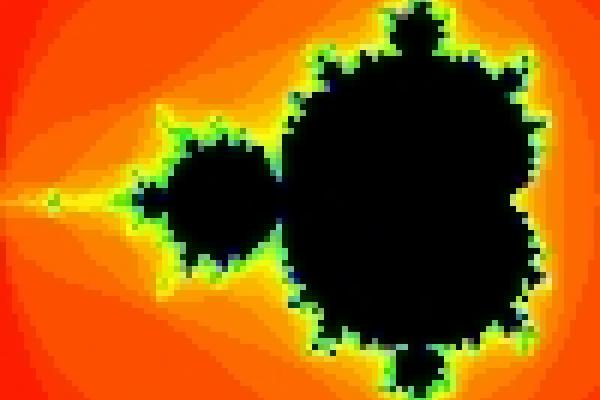
Almost everyone reading this article has no doubt encountered pictures from the Mandelbrot Set. Their appeal is not limited to the mathematician, and their breathtaking beauty has found its way onto posters, T-shirts and computers everywhere. Yet what is a fractal?
Extracting beauty from chaos
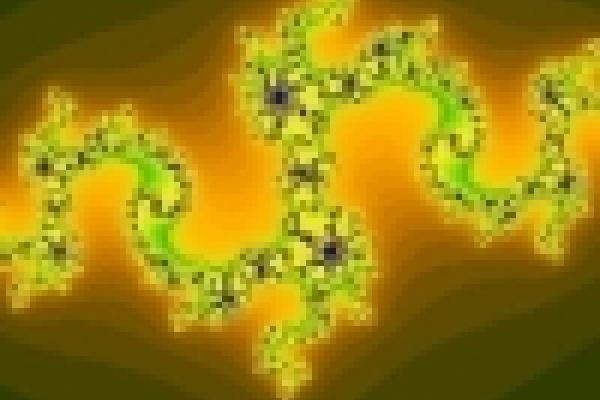
Images based on Lyapunov Exponent fractals are very striking. Andy Burbanks explains what Lyapunov Exponents are, what the much misunderstood phenomenon of chaos really is, and how you can iterate functions to produce marvellous images of chaos from simple mathematics.
The origins of fractals
The term fractal, introduced in the mid 1970's by Benoit Mandelbrot, is now commonly used to describe this family of non-differentiable functions that are infinite in length. Find out more about their origins and history.
Modelling nature with fractals
Computer games and cinema special effects owe much of their realism to the study of fractals. Martin Turner takes you on a journey from the motion of a microscopic particle to the creation of imaginary moonscapes.