

Home
plus.maths.org

Secondary menu

  • My list
  • About Plus
  • Sponsors
  • Subscribe
  • Contact Us
  • Log in
  • Main navigation

  • Home
  • Articles
  • Collections
  • Podcasts
  • Maths in a minute
  • Puzzles
  • Videos
  • Topics and tags
  • For

    • cat icon
      Curiosity
    • newspaper icon
      Media
    • graduation icon
      Education
    • briefcase icon
      Policy

    Popular topics and tags

    Shapes

    • Geometry
    • Vectors and matrices
    • Topology
    • Networks and graph theory
    • Fractals

    Numbers

    • Number theory
    • Arithmetic
    • Prime numbers
    • Fermat's last theorem
    • Cryptography

    Computing and information

    • Quantum computing
    • Complexity
    • Information theory
    • Artificial intelligence and machine learning
    • Algorithm

    Data and probability

    • Statistics
    • Probability and uncertainty
    • Randomness

    Abstract structures

    • Symmetry
    • Algebra and group theory
    • Vectors and matrices

    Physics

    • Fluid dynamics
    • Quantum physics
    • General relativity, gravity and black holes
    • Entropy and thermodynamics
    • String theory and quantum gravity

    Arts, humanities and sport

    • History and philosophy of mathematics
    • Art and Music
    • Language
    • Sport

    Logic, proof and strategy

    • Logic
    • Proof
    • Game theory

    Calculus and analysis

    • Differential equations
    • Calculus

    Towards applications

    • Mathematical modelling
    • Dynamical systems and Chaos

    Applications

    • Medicine and health
    • Epidemiology
    • Biology
    • Economics and finance
    • Engineering and architecture
    • Weather forecasting
    • Climate change

    Understanding of mathematics

    • Public understanding of mathematics
    • Education

    Get your maths quickly

    • Maths in a minute

    Main menu

  • Home
  • Articles
  • Collections
  • Podcasts
  • Maths in a minute
  • Puzzles
  • Videos
  • Topics and tags
  • Audiences

    • cat icon
      Curiosity
    • newspaper icon
      Media
    • graduation icon
      Education
    • briefcase icon
      Policy

    Secondary menu

  • My list
  • About Plus
  • Sponsors
  • Subscribe
  • Contact Us
  • Log in
  • Chalkboard saying Survivorship bias, surrounded by little planes

    Maths in a minute: Selection (and survivorship) bias

    15 June, 2026

    Selection bias happens when looking at a restricted data set leads you to wrong conclusions. An example is doing a voluntary survey to see if people like filling out surveys. You're only likely to get answers from people who do like filling out surveys, so the result tells you very little.
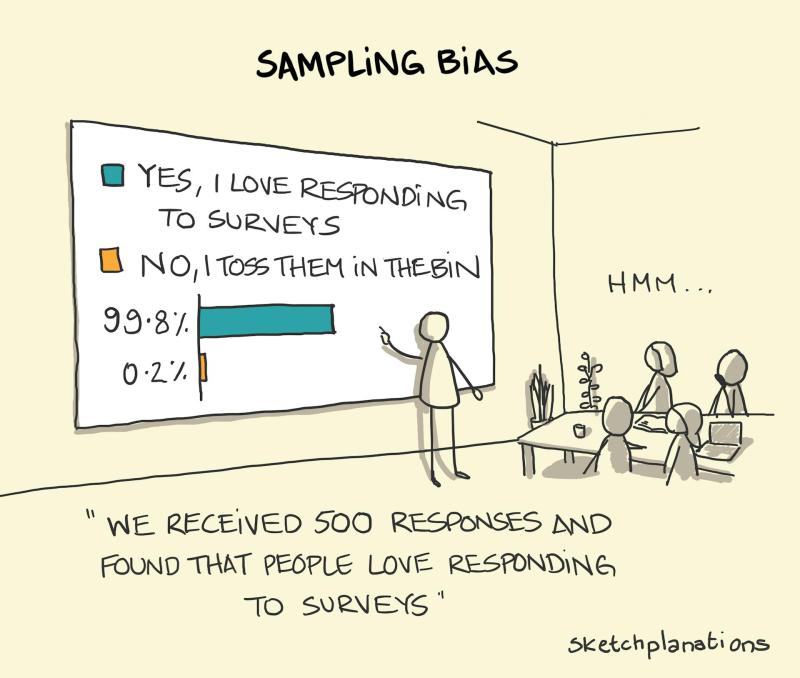
    Person standing in front of a screen with two options (Yes I love responding to surveys or No, I toss them in the bin). They say 'We received 500 responses and found that people love responding to surveys'
    Cartoon by Sketchplanations, CC BY-SA 4.0

    Other examples are using a basketball team to estimate the average height of the population, or care home residents to estimate the average age of the population. Both will give you skewed results. 

    These examples are quite obvious, but here's a more subtle one. In World War II the Statistical Research Group at Columbia University in the US was tasked with seeing how aircraft casualties could be reduced. The group looked at bomber planes that had returned from missions in Europe to see where they had been hit by bullets. They found that most of the damage was to the wings and the tail.
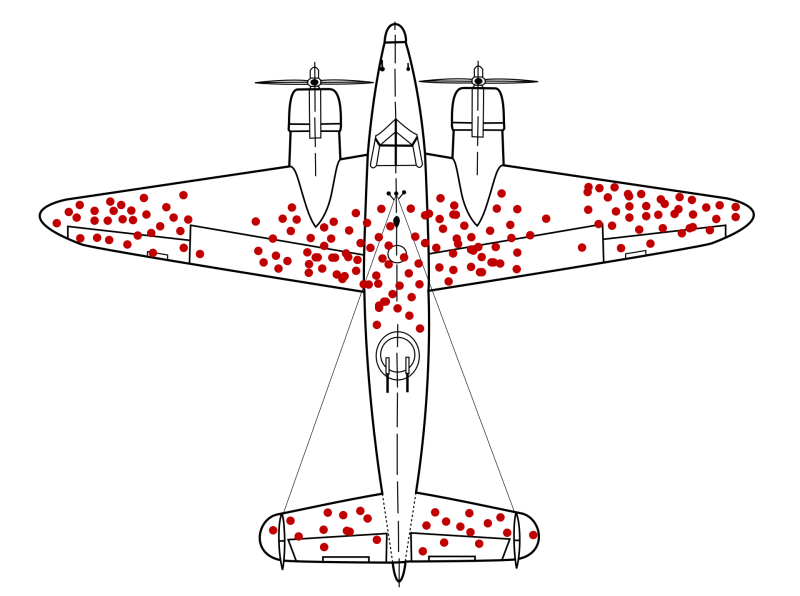
    Drawing of a bomber place with red dots across wings and tail
    Image by Martin Grandjean (vector), McGeddon (picture), US Air Force (hit plot concept); CC BY-SA 4.0.

    The conclusion seemed clear: reinforce the wings and the tail of planes since they are often hit.

    One member of the team, Abraham Wald, then spotted a fatal error in this reasoning. The planes that were examined by the group were the ones that had survived their missions. But perhaps they survived because they were only hit in the wings and tail and nowhere else. What should be reinforced then, are the regions of the plane where the surviving bombers had not been hit.

    The mistaken conclusion (to reinforce the wings and tail) is an example of survivorship bias: a situation where looking only at data that have survived a certain process (only planes that have returned) leads to an erroneous result. Survivorship bias is a particular type of selection bias. 

    The moral of the story is this: when analysing statistical data, make sure the data set you are looking at is as representative of the general population you want to study as it can possibly be. A gold standard in this context are randomised controlled trials — find out more in this Maths in a minute article.


    About this article

    This content was produced as part of our collaboration with the Isaac Newton Institute for Mathematical Sciences (INI) and the Newton Gateway to Mathematics.The INI is an international research centre and our neighbour here on the University of Cambridge's maths campus. The Newton Gateway is the impact initiative of the INI, which engages with users of mathematics. You can find all the content from the collaboration here.


    Isaac Newton Institute Logo
    Newton Gateway to Mathematics Logo
    • Log in or register to post comments

    You might also like

    article
    Two people running in a park

    The DAG behind the data

    How do you discern cause and effect when you can't do a controlled experiment? Directed acyclic graphs (DAGs) are a fun and important tool.

    article
    scrabble letters spelling bias

    Maths in a minute: Cognitive bias

    Cognitive biases shape how we understand data. Being aware of them gives us a better chance of avoiding bias.

    article
    Cat with umbrella

    Maths in a minute: Correlation versus causation

    Wet cats don't cause umbrellas and umbrellas don't cause wet cats.

    Read more about...

    statistics
    randomised controlled trial
    bias
    Maths in a minute
    INI

    Our Podcast: Maths on the Move

    Our Maths on the Move podcast brings you the latest news from the world of maths, plus interviews and discussions with leading mathematicians and scientists about the maths that is changing our lives.

    Apple Podcasts
    Spotify
    Podbean

    Plus delivered to you

    Keep up to date with Plus by subscribing to our newsletter or following Plus on X or Bluesky.

    University of Cambridge logo

    Plus is part of the family of activities in the Millennium Mathematics Project.
    Copyright © 1997 - 2026. University of Cambridge. All rights reserved.

    Terms