
Dive deeper into the loop soup
Brief Summary
Following on from the first article, which introduces Brownian loop soups, we explore a connection to the physics of elementary particles and how loop soups connect up space.
One thing we haven't mentioned so far is that a Poisson point process comes with a parameter called intensity, which measures the density of loops in the soup. A low intensity gives a sparse soup, like a broth with a few loop-shaped spaghettis thrown in. A high intensity gives a soup that is thick with loops. When you overlay two independent loop soups of the same intensity you get another loop soup with twice the intensity.
Something very special happens for one particular value of this intensity parameter. Suppose a loop soup contains two loops that touch at a point (and there will in fact be infinitely many such points). If you've not been told that it's two loops touching, you might think that the figure 8 comes from a single loop which intersects itself. Such a loop could have been created in two ways: by a Brownian motion that traces out a figure 8 as you would write it, or by a Brownian motion that first traces out a 3 and then continues the drawing to complete the 8.
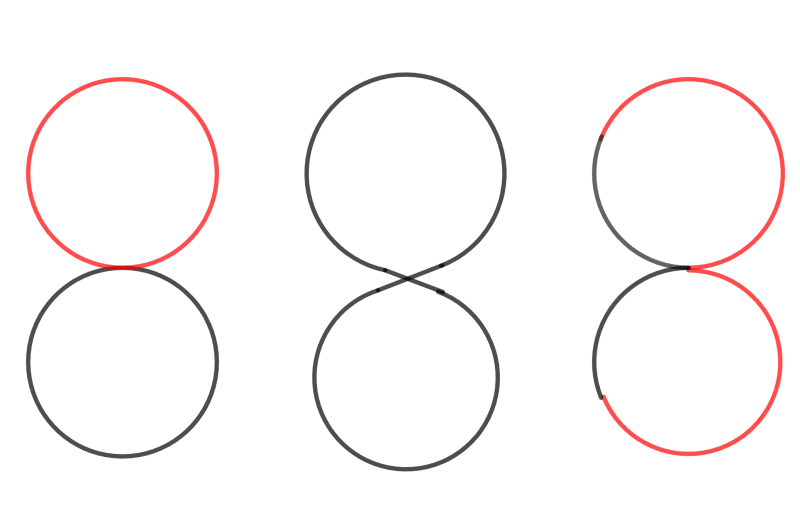
This gives exactly three options for how the figure 8 might have arisen. For generic values of the intensity parameter, the three possibilities have different probabilities of occurring within a soup, depending on whether the outcome corresponds to one or two loops. But for the special critical value of the intensity parameter, the three probabilities are the same.
This gives what Werner calls the rewiring property of such a critical loop-soup. When you come across a figure of 8 in the soup, you could choose at random which of the three possibilities it should be (with equal probabilities) and connect the four strands at the touching point accordingly. You might end up with a different soup than the one you had before rewiring (with different figure-of-8 connections), but the probabilistic law that determines the soup would remain the same.
The rewiring property of a critical soup means that, in a way, individual loops lose their identity. This reminded Werner of a phenomenon from quantum physics, concerning particles called bosons. When two bosons are in the same quantum state, they also their identity, in a sense, and can be interchanged.
And indeed, the connection between the critical loop soup and bosons goes deeper.
A link to nature?
Bosons are one of two types of particles that exist in the world. The other are fermions, which make up matter and include particles such as electrons and quarks.
Bosons can't build ordinary matter, but some of them act as messenger particles which mediate the fundamental forces of nature that act between fermions. They include the photon, which makes up light and can mediate the electromagnetic force.
To describe the behaviour of bosons in the simplest possible (and idealised) terms, physicists have come up with a mathematical object called the bosonic free field. Quantum physics tells us that particles, including bosons, don't behave like little balls but also have wave-like qualities. Quantum field theory assigns to each type of particle a sort of jelly (called a field) which permeates space. Individual particles manifest as ripples in the jelly. The jelly is a random and dynamic object. The bosonic free field describes the statistics of this randomness in the simplest case, for massless and non-interacting ripples.
"This structure can be connected directly to a Brownian loop soup," explains Werner. A loop soup comes with a mathematical object called the occupation field. Loosely speaking (and suppressing some details) it tells you the density of macroscopic loops at a given point in space. The occupation field is as random as the soup itself, so it's hard to predict what it'll look like. What you can do, however, is describe the statistics of this randomness.
And here's the thing. The occupation field statistics for the critical Brownian loop soup is intimately related to the bosonic free field. Indeed, the former is distributed exactly like the square of the latter. In other words, starting from a bosonic free field, one can construct the occupation field of a loop soup. Conversely, this suggests that to construct a bosonic free field from a loop-soup, one just needs to be able to choose at random a sign for each “island of loops” (see the box). In this sense, the critical Brownian loop soup gives you a geometric handle on the bosonic free field.
In order to make the previous link between the bosonic free field and the loop-soup work, an important idea is to work with a model that is intermediate between the continuous space and the discrete grid. The model is called a cable graph and consists of the discrete grid with the edges included.
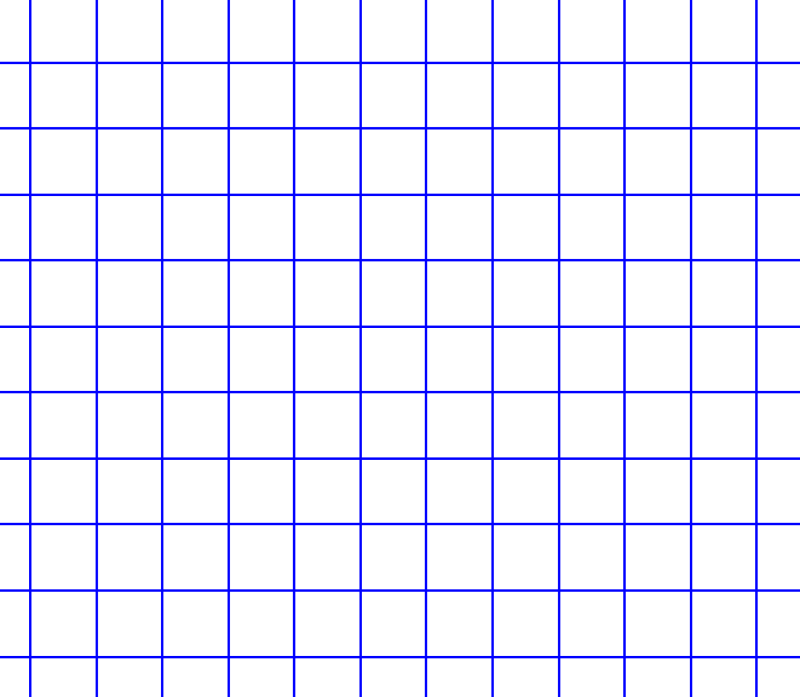
On a cable graph, Brownian motion can still move around continuously from one point to another, a little bit like an ant walking in thin tubes. One can then also define Brownian loop-soups on it. When the mesh-size of the cable-graph grid is very small, then the loop-soup on it will resemble a loop-soup in the continuous space, and the geometry of the random islands of connected loops will be related to features of the continuum bosonic free field.
Communication at a distance
The link between loop soups and the bosonic free field is a beautiful point of contact between probabilistic geometry and mathematical quantum physics. But sticking just to the geometry side, there are a number of other questions you can ask.
A critical loop soup typically contains many clusters of loops. One question is how the clusters of a critical loop soup connect up space. Given two points x and y, what's the chance they lie in the same cluster?
The answer is neat: the chance is related to the Newtonian potential, another way of describing Newton's law of gravitation. As the distance between the two points grows, the chance diminishes according to the same mathematical rule as the gravitational pull between two objects diminishes as the objects move further apart.
This, says Werner, is something "you sort of see directly" if you properly understand the connection between the loop soups and the bosonic free field. But he now dug a little deeper, asking what a critical loop soup might look like that has two far-away points x and y connected.
The answer, he showed, is intriguing. The soup looks exactly like a loop soup where the two points are not connected, but with a single Brownian path from x to y thrown in. As we know, two-ended paths are not allowed in a loop soup. You can only have loops. But the path overlaps with existing loops in such a way that, taken as one, the collection appears like a cluster of loops.
"This looks exactly like x sent out a message and did reach y, and the rest is untouched territory," says Werner. "I like that because it reminds me of my old issue of making sense of [communication at a distance between Earth and Moon]."
In a mathematical world that is somehow filled with a changing, evolving critical Brownian loop soup, a flash of "Brownian lightning" would occasionally connect up x and y. "They don't [need to] send out signals saying 'point y where are you?' [Instead] there will occasionally be these communication channels between the two points." No need to scream into the void.
This does not necessarily tell us something about the Earth, the Sun, or any other physical system we can see. But it's a lovely illustration of how a random structure made of (mostly) small loops can link up space even across large distances.
A magic caveat
Werner told this story about loop soups in March 2025, at the Isaac Newton Institute for Mathematical Sciences in Cambridge. He was addressing an eminent audience which included members of the Executive Committee of the International Mathematical Union (you can watch a recording of the talk here). Werner was himself a member of this committee between 2011 and 2018.
But since then, exciting progress has been made. Werner's statement holds in any cable-graph, even in a cable-graph grid in higher dimensions of space. We can't visualise these higher dimensions, but there's a way of describing them mathematically (see here). When the mesh-size of the grid decreases to zero, large Brownian loops on the cable graph converge to large continuum Brownian loops in this limit. But there are also tiny little microscopic loops living on the grid which disappear in the limit. As Werner puts it, their limit forms a sort of infinitesimal powder sprinkled randomly through space.
If you're working in the two-dimensional plane, it has been shown that this powder can be ignored — taking it away won't make a difference to the connections within the soup. But as Werner observed some time ago, the powder is necessarily crucial when the dimension is 4 or higher. In dimensions 4 and 5, it acts as an infinitesimal, magic glue which holds the large loops together.
So what about dimension 3? In the autumn 2025 Zhenhao Cai and Jian Ding proved that some magic glue is also there. Werner had somehow initially thought this was not going to happen, but he finds the fact that it does in our physical 3-dimensional space very exciting.
"[So in dimensions 3 and higher the way that continuum loops are connected in the limit] is an overlay of two complementary things," Werner explains. "The chain of macroscopic loops that do intersect and the [powder which plays the role of infinitesimal random glue]. There's just enough of it to create further connections."
Whether this powder echoes a feature of the real world is a question better left to fancy.
From soups to reality
Werner came up with the idea of the Brownian loop soup together with Gregory Lawler in the early 2000s and has been instrumental in developing the theory alongside Yves Le Jan, Titus Lupu and others. But can the soup really tell us anything about reality? It's connected to the bosonic free field and captures the randomness which, according to quantum mechanics, characterises the world at small scales. It says something evocative about points being connected in space. Might there even be a link to string theory, a candidate for a theory of everything which holds that nature's fundamental constituents are tiny little vibrating strings?
"It's the usual trap for mathematicians," says Werner. "We understand one mathematical structure and then we say 'now I can explain the whole world'." There are indeed plenty of stories of mathematics revolutionising physics by providing just the right tools or points of view. But for each mathematical success story there are plenty of instances of mathematicians' flights of fancy being neither useful nor welcome in the world of physics.
"The goal is not the same," says Werner. "Mathematicians want to [have fun] looking at nice maths objects and nice proofs. We have the luxury of [not caring whether these things are of any use]. But physicists, at the end of the day, want to confront their theories with experiments."
Werner thinks he was lucky that his previous research, which earned him a Fields medal, turned out to provide a viewpoint that was fundamentally different from the one developed by physicists. The Brownian loop soups didn't come from out of nowhere, they are mathematically related to Werner's earlier work. But he doesn't want to overplay those aspects of Brownian loop soups that seem to make them physically relevant. His understanding of particle physics and quantum physics, he points out, is "kindergarten" and the bosonic free field is a very trivial object in Quantum Field Theory.
For now Werner continues to think about these loop-soup questions, and to smile.
About this article
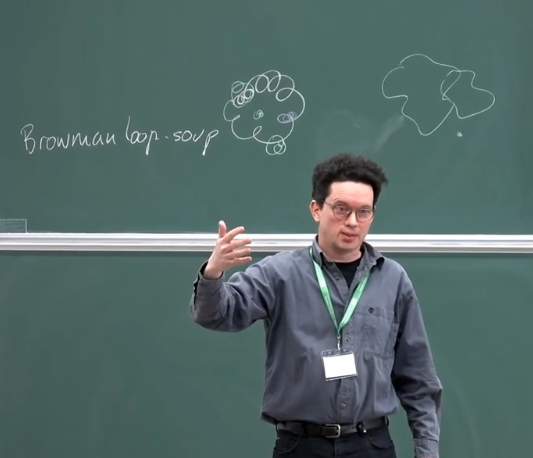
Wendelin Werner is Rouse Ball Professor of Mathematics at the University of Cambridge.
Marianne Freiberger, Editor of Plus, interviewed Werner in March 2026, after attending his talk at the IMU-INI Mathematical Colloquia and Panels at the Isaac Newton Institute for Mathematical Sciences in March 2025.
This content forms part of our collaboration with the Isaac Newton Institute for Mathematical Sciences (INI) – you can find all the content from the collaboration here.
The INI is an international research centre and our neighbour here on the University of Cambridge's maths campus. It attracts leading mathematical scientists from all over the world, and is open to all. Visit www.newton.ac.uk to find out more.
