

Dive into the loop soup!
Brief Summary
Fields Medallist Wendelin Werner explains why he loves random structures known as Brownian loop soups.
Which shape is the most natural? The ancient Greeks were fond of the Platonic solids which they related to the four elements of earth, air, water and fire. Circles and spheres, so perfect yet so simple, are also popular candidates. Enthusiastic mathematicians are researching them as we speak. Or perhaps you favour fractals, whose infinite intricacy reflects the shape of clouds, plants, coastlines, and even our lungs.
For mathematician Wendelin Werner the most natural shape is a Brownian loop. It is a random object, but in some way, it embodies more symmetries than circles do. Out of many Brownian loops you can construct another random — yet highly symmetric — structure, which Werner calls a loop soup.
"If you lie in your bed at night and you think, what's the most elementary, natural, possibly physically relevant random structure, it's possible to convince yourself that the Brownian loop soup is a prime candidate," he says jokingly. "It's the simplest thing that has it all."
How does it work ?
Werner loves the Brownian loop soup mostly because it "makes him smile". But there's also an intuitive aspect inspired by some of his first encounters with the laws of physics. At school Werner learnt about Newton's law of universal gravitation. It describes how the gravitational attraction between two objects — such as the Sun and the Earth — depends on their distance.
But the young Werner wasn't happy with mere description. "I raised my hand and said something like, 'thank you very much, this is great, but how does it work? What is travelling between the Sun and the Earth that somehow measures the distance and creates the gravitational force in terms of the distance?” The question, simple but pertinent, stuck in his head.
Brownian motion is your friend
Apart from thinking about the laws of physics, Werner has also always been interested in chance. "I've always liked things involving randomness, playing board games and so on," he says. "I also liked continuum structures and the mathematics that comes with it. And when I first encountered Brownian motion, I thought 'this is my friend – I will be happy to think about this mathematical object'."
Continuous versus discrete
When you roll a die while playing a game you are dealing with whole numbers, which are isolated entities: the whole numbers form a discrete set. But there are also continuous objects in mathematics, such as the continuous line defined by the entire ruler, or continuous functions. The field of mathematics that deals with continuous functions is called analysis and the mathematical tool set it provides is known as calculus.
The loops in the soup arise from this Brownian friend. In 1827 the botanist Robert Brown discovered, while looking through his microscope at grains of pollen suspended in water, that particles perform a zig-zaggy random motion. Specks of dust do the same while floating through air. People thought the particles do this because they are constantly being knocked about by random collisions with air or water molecules. The problem was that, at the time, nobody knew whether atoms and molecules actually existed.
Albert Einstein came to the rescue. In 1905 he used the statistical analysis of what's now called Brownian motion in order to estimate how many atoms and molecules there are in one mole of any substance (he estimated Avogadro's number). Einstein's work, later confirmed by Jean Perrin, helped to convince people that atoms and molecules are real. Perrin received the 1926 Nobel Prize in Physics for his contribution.
Brownian motion can be thought of as a real physical thing, but it is also a purely mathematical concept. The definition is not straightforward, see here, but you can get some intuition via what's known as a drunkard's walk.
Imagine you start at some point in space and pick a direction at random. You take a step in that direction and then pick a random new direction independently of the first step. You take a step in that direction, again pick a new direction, and so on, potentially forever. That's a drunkard's walk, also known as a random walk, and it's a discrete object: a sequence of points defined by your random sequence of directions.
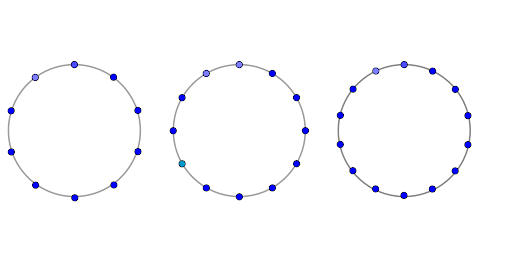
Now imagine letting the size of your steps get smaller and smaller, tending to zero. This might be hard to visualise, so to clarify the idea, think about taking a sequence of steps around a circle. The discrete steps give you points on the circle. Letting the step size tend to zero, making sure you add in more steps as you go, causes the points to merge in the limit, to form a continuous curve: the circle you were walking around.
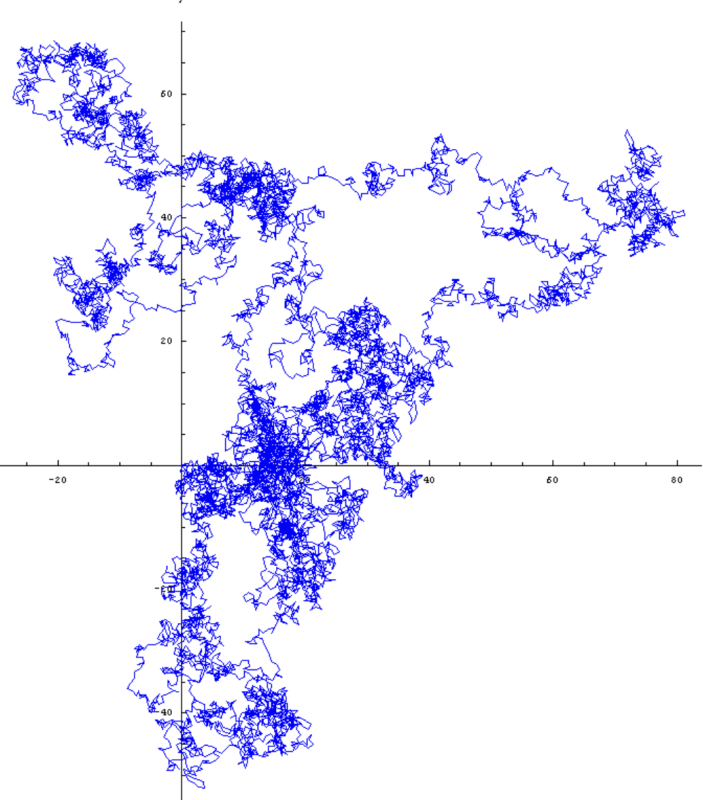
There's also a way of taking a scaling limit (as it's called) of a drunkard's walk, but the result won't be as smooth. The curve you end up, intuitively speaking, constantly changes direction at random. It also has infinite length. In fact, it's a fractal.
Continuous or discrete?
Thinking of a continuous random object as a scaling limit of something discrete lends a lot of intuition, which comes from properties of the discrete object that are well-understood. It's a successful line of thought that has been favoured by physicists studying all sorts of things, not just specks of dust.
But Werner points out that you don't have to do it this way. "One can also start with a continuum object and study it directly, rather than [going via a scaling limit]," he says. "Sometimes this approach reveals new things that [otherwise] remain undercover."
One of the results Werner obtained in his Fields Medal work, with his collaborators, was the proof of a conjecture first posed by Benoit Mandelbrot, famous for the fractal that carries his name. The conjecture concerned fractal properties of the “outer boundary” of a Brownian motion in the plane, or long random walks. The proof of Werner and his collaborators Greg Lawler and Oded Schramm very much belonged to the continuum world.
In Werner's case this has definitely been true. Having studied Brownian motion for his PhD in the early 1990s, he went on to win many prizes for further work on various other jittery and random paths inspired by physics. In 2006 he was awarded a prestigious Fields Medal for work representing, according to the prize citation, "one of the most exciting and fruitful interactions between mathematics and physics in recent times."
Twenty years on, with prizes in his pockets, a professorship at the University of Cambridge, and a prestigious grant from the Royal Society, Werner is in a position to sit back and think about the things that make him smile.
Cooking up a loop soup
So let's think about loop soups. A Brownian loop is Brownian motion that ends where it started — we can think of it simply as a loop, forgetting which point on it was the start-end point. A Brownian loop can be defined mathematically by adapting a Brownian motion accordingly. A loop soup is a collection of Brownian loops that, as Werner suggests, is as natural as possible.
But what do we mean by "natural"? One way of defining this notion is to say it should not involve conscious, arbitrary choices. As soon as you choose that a structure should look this way rather than that way it becomes, in some sense, less universal. By this reckoning circles and spheres are good. All you need to choose to define a circle or a sphere is its size.
Looking for symmetries, we see that rotating a circle around its center does not change it, but that rotating it around some other point gives another circle.
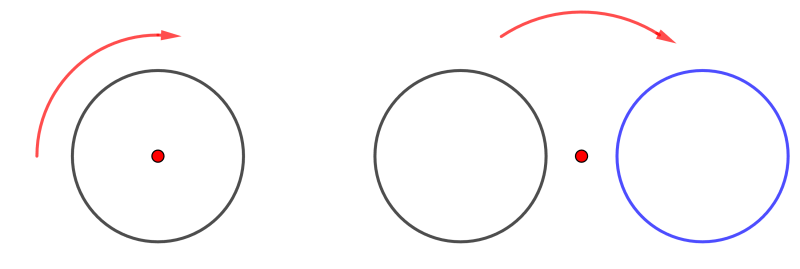
Brownian loops are random objects, and if you choose any realisation of such a random object and rotate it, you do not get the loop that you started with. However, “the law” of the rotated object (the rule that generated it) can be identical to the one that you started with.
There is then a trick to construct scale-invariant structures associated with deterministic as well as random shapes.
“Suppose that spheres of all sizes pop up a bit everywhere at random in space," says Werner. "In this way, you end up with a random collection of spheres that are somewhat all over the place. Any given point will typically not be the centre of any of the spheres, but it will be in the inside of infinitely many smaller and smaller spheres. If you do this appropriately and look at the obtained random picture with a magnifying glass, you see another random picture that has the same law as the picture you started with.”
Mathematicians say that this law is scale-invariant. Mathematically speaking, this picture is a Poisson point process of spheres. Such Poisson point processes are often used to approximate random arrangements in nature, such as trees dotted through an arid landscape or tiny bubbles in a pane of glass.
A Brownian loop soup is similarly constructed by randomly placing Brownian loops in space instead of spheres. Each individual loop does come with a particular size — it may be a fractal with infinite length, but it most definitely has a finite diameter. So that the same idea applies.
The law of the Brownian loop-soup is therefore scale-invariant, and it is similarly rotation-invariant: if you rotate the loop soup the picture you see has the same law.
The loop soup is quite universal: To define it you don't even rely on a notion of size or distance. All you need is an ability to choose random directions to define the individual loops. (Technically, you need a local sense of infinitesimal isotropy, which is related to fundamental concepts in analysis, such as the Laplacian or harmonic functions.)
When you are creating the loop soup in two-dimensional space (the loops are all drawn in a piece of the plane), there is an even stronger invariance: the underlying probabilistic distribution remains the same, not just when you scale the picture, but when you transform it using any transformation of the plane that preserves the size of angles (this is known as conformal invariance). This stronger property fails to be true for circles!
Working in this two-dimensional setting is what a lot of Werner’s work has been about. After his Fields Medal work, he has for instance shown how the two-dimensional loop soup can be used to construct random structures related to what physicists refer to as conformal field theory.
Symmetry is immunity to change

This image of a butterfly is symmetrical. You can reflect it in the central vertical axis and it'll look (almost) identical. This illustrates that symmetry is immunity to change. A circle possesses even more symmetry as you can rotate it around its centre through any angle, and reflect it in any axis running through its centre, without changing its appearance. Mathematical objects, such as equations and indeed loop soups, can also possess symmetries if they do not change when you apply a transformation.
In summary, a Brownian loop soup uses mathematicians' favourite model of random motion (Brownian motion) and combines it with a favourite rule for random arrangements (the Poisson point process) to create a structure that doesn't favour any location in space, any scale, or any orientation. It remains the same under many types of transformations. To mathematicians immunity to change is synonymous with symmetry, so in this sense the Brownian loop soup is highly symmetric.
It might not be the first thing to pop into most people's heads while lying in bed, but perhaps it starts to become clearer now why Werner likes it so much.
There is more to Brownian loop soups, however, including a deep link to nature. Find out more in the next article.
About this article
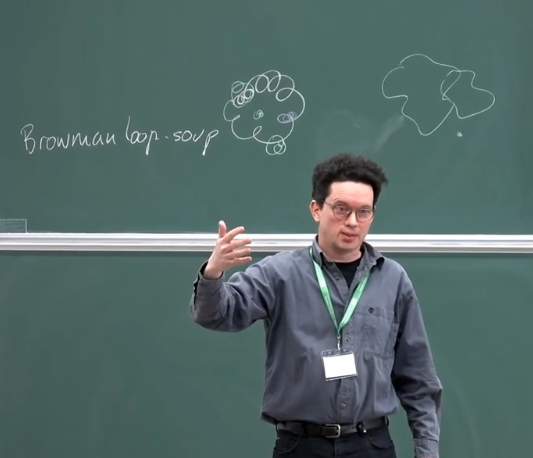
Wendelin Werner is Rouse Ball Professor of Mathematics at the University of Cambridge.
Marianne Freiberger, Editor of Plus, interviewed Werner after attending his talk at the IMU-INI Mathematical Colloquia and Panels at the Isaac Newton Institute for Mathematical Sciences in March 2025.
This content forms part of our collaboration with the Isaac Newton Institute for Mathematical Sciences (INI) – you can find all the content from the collaboration here.
The INI is an international research centre and our neighbour here on the University of Cambridge's maths campus. It attracts leading mathematical scientists from all over the world, and is open to all. Visit www.newton.ac.uk to find out more.
