
Home
plus.maths.org

Secondary menu

  • My list
  • About Plus
  • Sponsors
  • Subscribe
  • Contact Us
  • Log in
  • Main navigation

  • Home
  • Articles
  • Collections
  • Podcasts
  • Maths in a minute
  • Puzzles
  • Videos
  • Topics and tags
  • For

    • cat icon
      Curiosity
    • newspaper icon
      Media
    • graduation icon
      Education
    • briefcase icon
      Policy

    Popular topics and tags

    Shapes

    • Geometry
    • Vectors and matrices
    • Topology
    • Networks and graph theory
    • Fractals

    Numbers

    • Number theory
    • Arithmetic
    • Prime numbers
    • Fermat's last theorem
    • Cryptography

    Computing and information

    • Quantum computing
    • Complexity
    • Information theory
    • Artificial intelligence and machine learning
    • Algorithm

    Data and probability

    • Statistics
    • Probability and uncertainty
    • Randomness

    Abstract structures

    • Symmetry
    • Algebra and group theory
    • Vectors and matrices

    Physics

    • Fluid dynamics
    • Quantum physics
    • General relativity, gravity and black holes
    • Entropy and thermodynamics
    • String theory and quantum gravity

    Arts, humanities and sport

    • History and philosophy of mathematics
    • Art and Music
    • Language
    • Sport

    Logic, proof and strategy

    • Logic
    • Proof
    • Game theory

    Calculus and analysis

    • Differential equations
    • Calculus

    Towards applications

    • Mathematical modelling
    • Dynamical systems and Chaos

    Applications

    • Medicine and health
    • Epidemiology
    • Biology
    • Economics and finance
    • Engineering and architecture
    • Weather forecasting
    • Climate change

    Understanding of mathematics

    • Public understanding of mathematics
    • Education

    Get your maths quickly

    • Maths in a minute

    Main menu

  • Home
  • Articles
  • Collections
  • Podcasts
  • Maths in a minute
  • Puzzles
  • Videos
  • Topics and tags
  • Audiences

    • cat icon
      Curiosity
    • newspaper icon
      Media
    • graduation icon
      Education
    • briefcase icon
      Policy

    Secondary menu

  • My list
  • About Plus
  • Sponsors
  • Subscribe
  • Contact Us
  • Log in
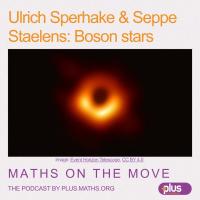
  • Boson Stars podcast image

    Ulrich Sperhake and Seppe Staelens: Boson stars

    6 July, 2026

    Welcome to the latest episode of Maths on the Move! In this episode we spoke to Cambridge Professor of Theoretical Physics Ulrich Sperhake and his graduate student, Seppe Staelens, about boson stars: hypothetical objects that might be masquerading as black holes.

    Our conversation with Ulrich and Seppe marked the tenth anniversary of the first detection of gravitational waves. As Ulrich explained back then, gravitational waves "opened our ears to the Universe in a waveband in which we have been 100% deaf up to now" and they also help us understand black holes and boson stars. In this podcast Seppe and Uli explain more, taking us to the frontiers of current research..

    To find out more about the topics discussed in this podcast, you might like:

    • A short explainer of gravitational waves
    • Gravitational waves reveal cosmic hum: another podcast with Ulrich
    • Dark stars: an article on gravitational waves and boson stars

    Maths on the Move, is the podcast from plus.maths.org. We speak to researchers from the frontiers of mathematical science so you can connect with the maths that shapes and explains our world. Hosted by Plus editors Rachel Thomas and Marianne Freiberger.

    • Log in or register to post comments
    You can listen to the podcast using the player above, and you can listen and subscribe to our podcast through Apple Podcasts, Spotify and through most other podcast providers via podbean.
    Photo of Ulrich wearing sunglasses

    Ulrich Sperhake

    contributor
    Seppe Staelens

    Seppe Staelens

    contributor

    Marianne Freiberger

    Marianne Freiberger

    host
    Rachel Thomas

    Rachel Thomas

    host

    You might also like

    article

    Dark stars

    Gravitational waves have provided a wealth of information about black holes. But could other objects be hiding in this data too? Researchers are exploring this idea, which may also help resolve the mystery of dark matter.

    article
    simulation

    Boson stars: Beyond vanilla

    Physicists have figured out how we might detect hypothetical boson stars. If we do, then this would count as a major step towards solving the riddle of dark matter,

    article

    Maths in a minute: Gravitational waves

    A quick introduction to one of the greatest discoveries of the century.

    Read more about...

    gravitational wave
    boson
    theoretical physics
    University of Cambridge
    Black holes

    Plus delivered to you

    Keep up to date with Plus by subscribing to our newsletter or following Plus on X, Bluesky, Facebook or LinkedIn.

    University of Cambridge logo
    Twitter / X logo Bluesky logo LinkedIn logo

    Plus is part of the family of activities in the Millennium Mathematics Project.
    Copyright © 1997 - 2026. University of Cambridge. All rights reserved.

    Terms