
Scotland and Ireland to host the international maths community
Brief Summary
We talk to the team behind the Glasgow and Dublin bid about their plans for the 2030 International Congress of Mathematicians.
It's official! The International Congress of Mathematicians 2030 will be held in Glasgow. The General Assembly of the International Mathematical Union (IMU), which always precedes the Congress, will be held in Dublin.
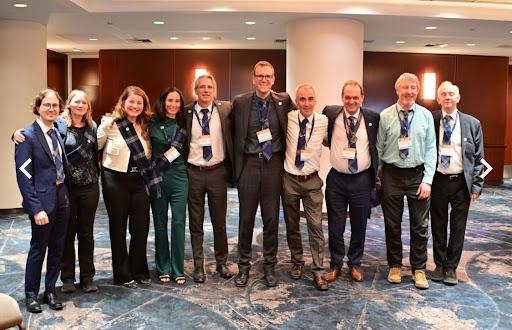
The joint Glasgow/Dublin bid won the vote at this year's IMU General Assembly in New York by a very large margin. It will be the first International Congress of Mathematicians (ICM) to take place in Europe in 24 years and the first one to be held in the UK since 1958.
"[When presenting a bid] you have to be very clear about what it is that you want to do," says Michael Wemyss of the University of Glasgow and member of the bid team. "And we were. We are very proud of the fact that we won on our terms — we know what we want to do and we'll do it."
The idea of holding a ICM first occurred to the team after organising a large national maths conference (the joint BMC/BAMC) to take place in Glasgow in April 2020. The event was cancelled due to COVID-19, and eventually took place online in 2021. It was a successful conference, "but it really rammed home that you go to conferences to speak to people. So we began conversations with a lot of people from around the world — if we were to bid for the ICM, what should the bid look like?" Slowly, over the course of a few years and with crucial support from the Glasgow Convention Bureau, the central ideas emerged.
Three principles
The bid is based on three key principles. "The first and absolutely key idea is that participants are the most important thing," says Wemyss. "The International Congress of Mathematicians should be a celebration of just that – the mathematicians."
What makes the ICM unique, say the team, is that it connects people who would never meet at subject specific conferences. "So our second principle is about maximising the opportunities for meetings to happen." All venues that people will use, from the conference venue to hotels, cafes, restaurants, and bars, will be contained within a 2km radius within the city of Glasgow. "It's the idea of a city takeover. Wherever you go you will find mathematicians — because when you're in a social situation, you're much more likely to start chatting."
The third, and equally central, principle is that mathematics is internationally collaborative so the ICM should be too. This is how the collaboration with Dublin came about. Since it's logistically impossible (even for mathematicians) to move the projected 6000 participants between two cities in a day, it was decided to hold the IMU General Assembly in Dublin while the ICM itself will take place in Glasgow.
One maths graduate who championed the bid from early on is James Lawless, Irish Minister for Further and Higher Education, Research, Innovation and Science. "The General Assembly and International Congress of Mathematicians will be a landmark event, showcasing Ireland and Scotland's shared commitment to excellence in mathematics, research and education," he says in the official press release.
An ICM for the world
Apart from connecting mathematicians, an ICM also provides opportunities to connect mathematics with the outside world. "The Scottish and Irish governments have both agreed to hold a Year of Mathematics in 2030," says Tiffany Vlaar of the University of Glasgow and member of the bid team. "We already have lots of outreach communicators signed up and are planning outreach activities in different languages — we want to really make it an ICM for the world."
The team think the bid was so successful because, over a period of 18 months, they reached out to every single IMU adhering organisation around the world, to start conversations. "So our bid articulated universal values in the mathematical community, and got a lot of buy-in through that," says Wemyss. All sorts of decisions followed on from such conversations — from making outreach activities multi-lingual to recording talks so that people in different time zones can watch when they want to. "We're very open to continuing to have these conversations," says Vlaar. "Anyone is welcome to contact us."
Once the team are back in the UK preparations will begin in earnest. Apart from addressing a host of logistical questions, they want to think hard about how to enable mathematicians from the broadest range of countries and career stages to participate and get the most out of the ICM. This will involve the IMU Committee for Developing Countries and thinking about funding more generally.
The City of Glasgow is firmly onside. "I'm excited to welcome the global mathematics community to Glasgow!" Beverley McLean of the Glasgow Convention Bureau, a key member of the bid team, posted on LinkedIn. "I have no doubt that both the city and our bid partner, the Scottish Event Campus (SEC), will provide an outstanding stage to showcase everything Glasgow has to offer."
It will be an exciting, and very busy, four years but there's plenty of commitment to see the team through. In the words of Damian Gvirtz-Chen, another member of the bid team from the University of Glasgow: "I remember the email from Michael first floating the idea of holding an ICM. My gut reaction was yes, yes, yes! There was never any doubt that this will be important for mathematics in the UK and for mathematics in Scotland and Ireland, and that we should really go for it."
About this article
Marianne Freiberger is Editor of Plus. Together with Rachel Thomas she interviewed Damian Gvirtz-Chen, Tiffany Vlaar and Michael Wemyss at the International Congress of Mathematicians in July 2026.
This content was produced as part of the collaboration between plus.maths.org and the London Mathematical Society and with kind support of the Institute of Mathematics and its Applications.